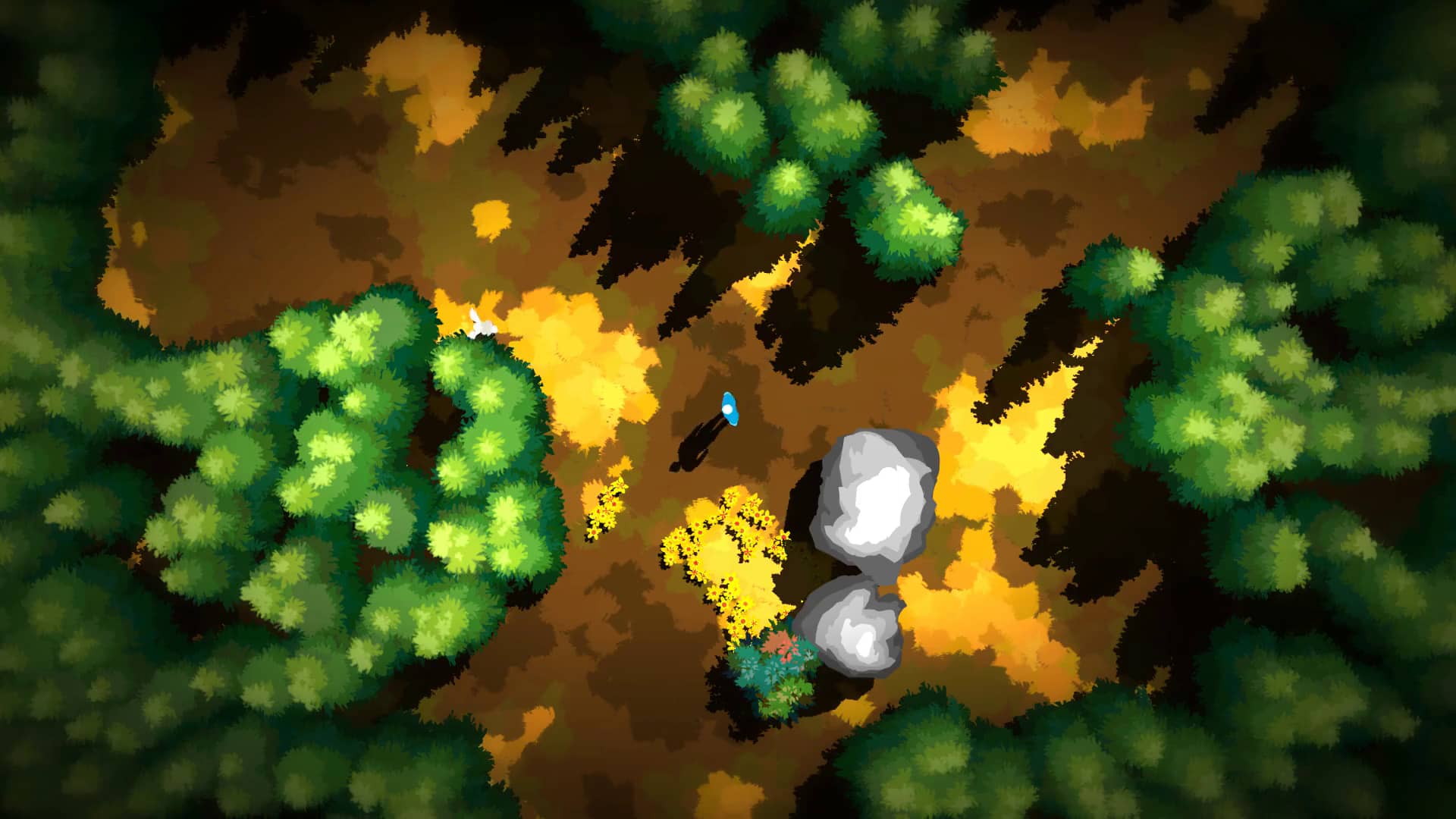
After over 4 years of development, Future Unfolding finally has a release date. It's coming to PC and Mac on March 15. You'll be able to buy it on Steam, Humble Store, itch.io and the Mac App Store. PlayStation 4 will follow later this year. Check out our new trailer below.
We just made a new trailer for the Greenlight campaign of Future Unfolding. While we’ve worked with very talentedpeople on previous trailers, we decided to produce this “in-between” trailer ourselves to keep our costs down. It took some time to research the best way to record gameplay footage, so I wrote down our setup here.
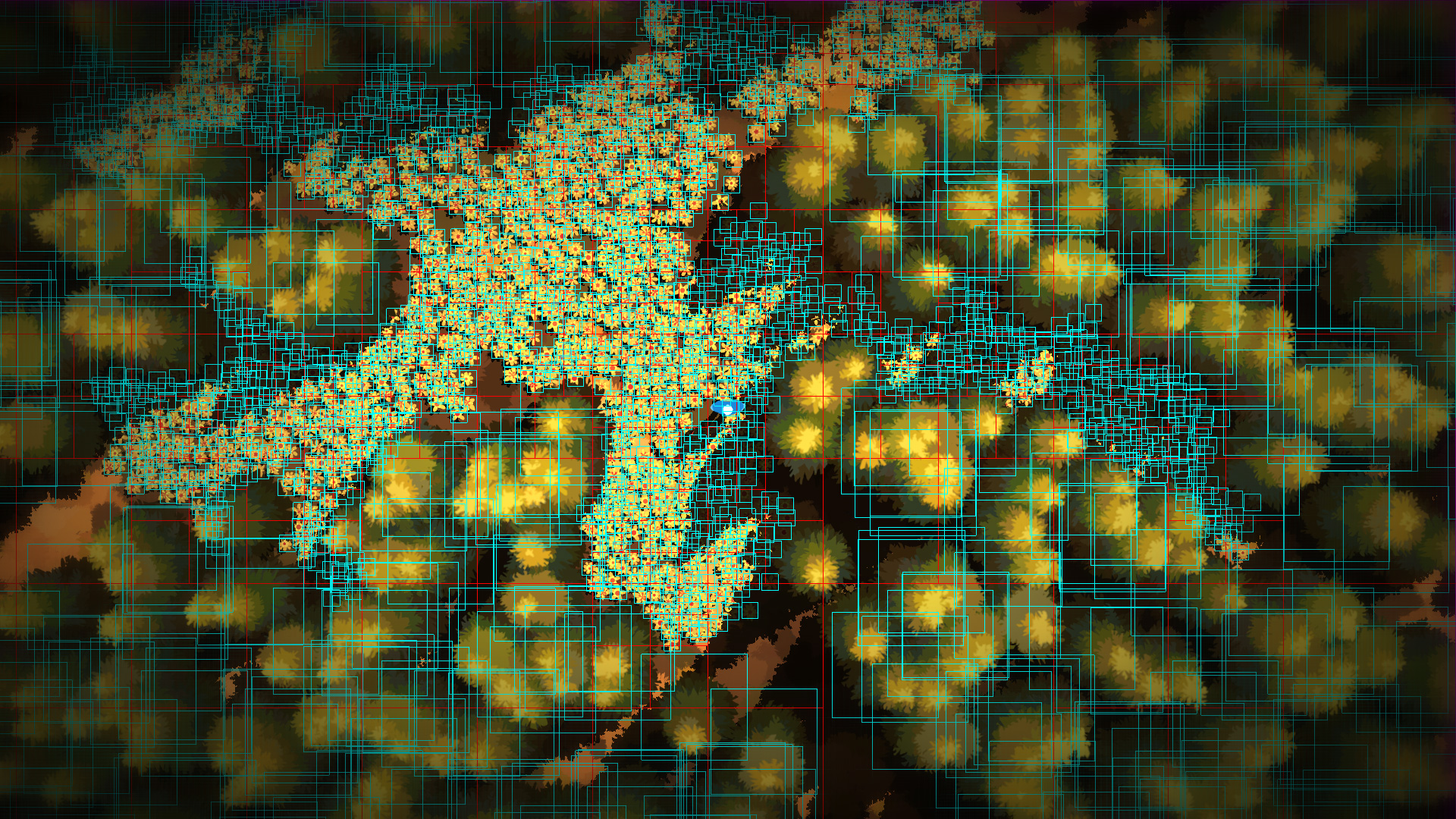
Future Unfolding is a graphics intensive game, with a world that is composed out of thousands of dynamic objects. Our goal was to record in lossless quality at 1080p and 60fps, so we could edit in Adobe Premiere Pro and export it with settings that are optimized for YouTube. If your gameplay footage is not lossless to begin with, there is a risk your final video will have artifacts resulting from compressing it twice, once at capture and once at export.
After trying out different solutions, we settled on OBS Studio (0.15.4) on Windows 10 to record the footage. OBS is free & open-source and offers a lot of fine-grained control over its settings. Below are the settings we used. Note that your specific game might have different requirements, and your hardware might be different, so it’s always worth to play around with the settings and do some test recordings to find the best setup.
Renderer: Direct3D 11
This is a bit counter-intuitive since the game actually uses OpenGL, but Direct3D is better for capturing video on Windows.
Resolution: 1920x1080
FPS: 60
If you have problems to record at 60fps, try a lower resolution to record at. Higher frame rates usually trump higher resolution for gameplay videos.
Recording path: If possible record your footage on a SSD, and move the files to a hard drive afterwards if you need the space. Recording to a slow-spinning hard drive will be a bottleneck for lossless recording.
Encoder: NVENC H.264
The encoder you should choose depends on your graphics card, so it’s worth experimenting what encoder works best in your case. We used a GeForce GTX 970.
Rate Control: Lossless
Keyframe Interval: Auto
Preset: High Performance
Use Two-Pass Encoding
To get the best recording performance out of your computer, make sure you have the latest driver for your graphics card installed. Also, close all applications except for OBS and your game. Don’t forget to close applications that run in the background such as Dropbox, Adobe Creative Cloud or Steam.
If you experience stuttering in your lossless recordings, you have to determine if the stutter occurs at playback, or if it’s actually present in your recording. The way we evaluated our test recordings was to export them in Premiere Pro with YouTube settings, upload them to YouTube and then judge the frame rate there.
We often hear two things from people who see Future Unfolding for the first time: 1) They are surprised that we’re not using Unity. 2) They can’t figure out how we created the look of the game. These two things are directly related to each other.
Unity has become so popular among indie developers, it is often the default choice. However, when you're using Unity, it's easy to make a game that looks like it was made in Unity. The tools shape the things we make with them.
For Future Unfolding we decided to custom-build exactly the tech we need to match our creative vision. Our code is written in C/C++. We use OpenGL and SDL2, but everything is setup in a way that we can swap out these libraries with something else (e.g. DirectX) without too much effort. This leaves the door open for us to do ports inhouse. We reused a few parts here and there from our previous game Spirits, so we didn't have to start completely from scratch.
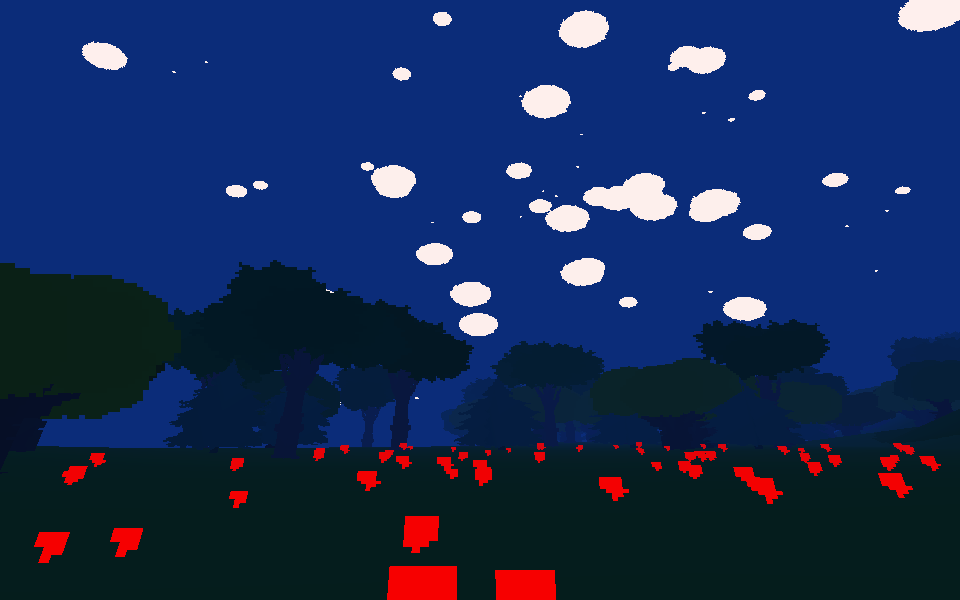
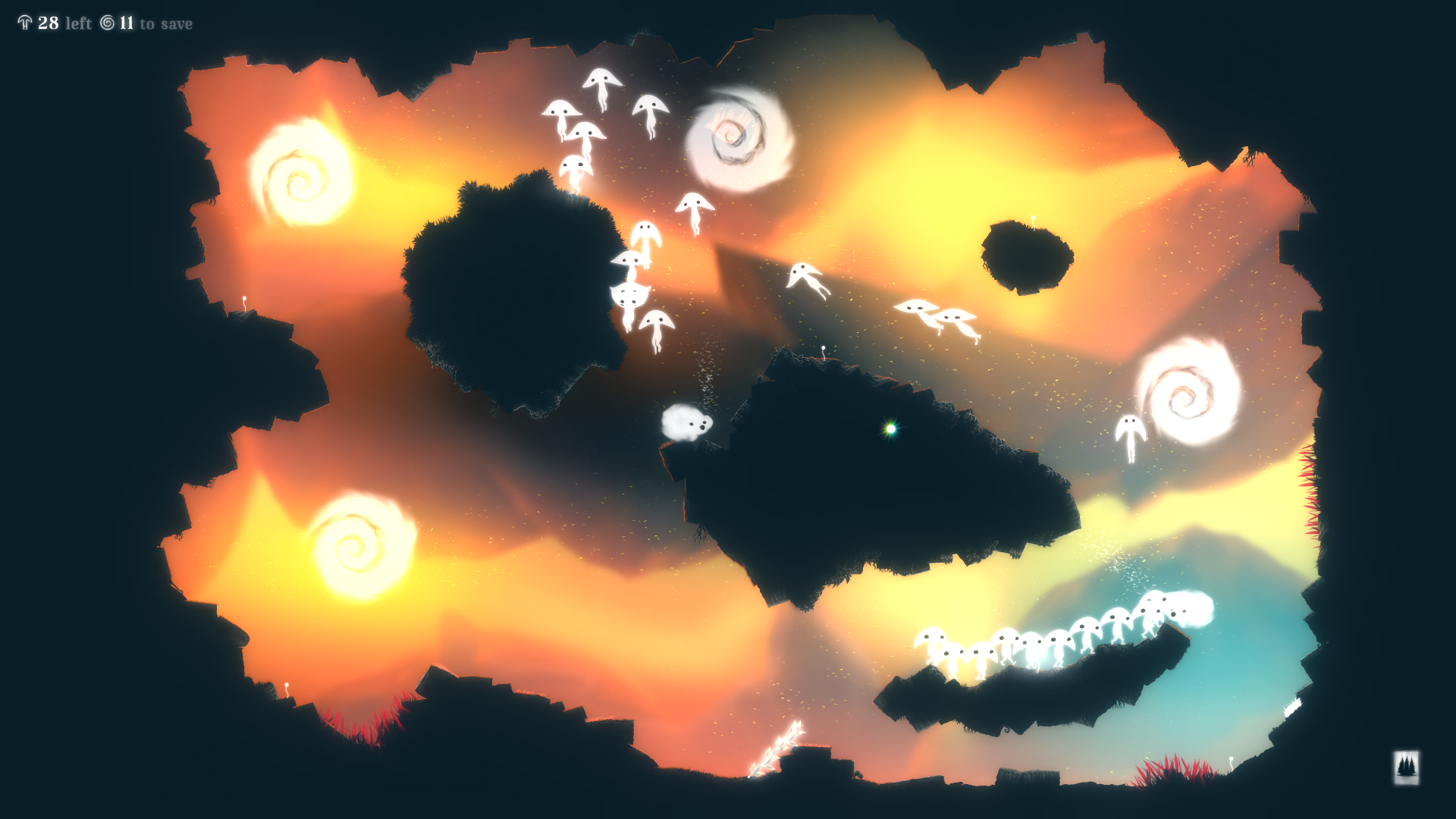
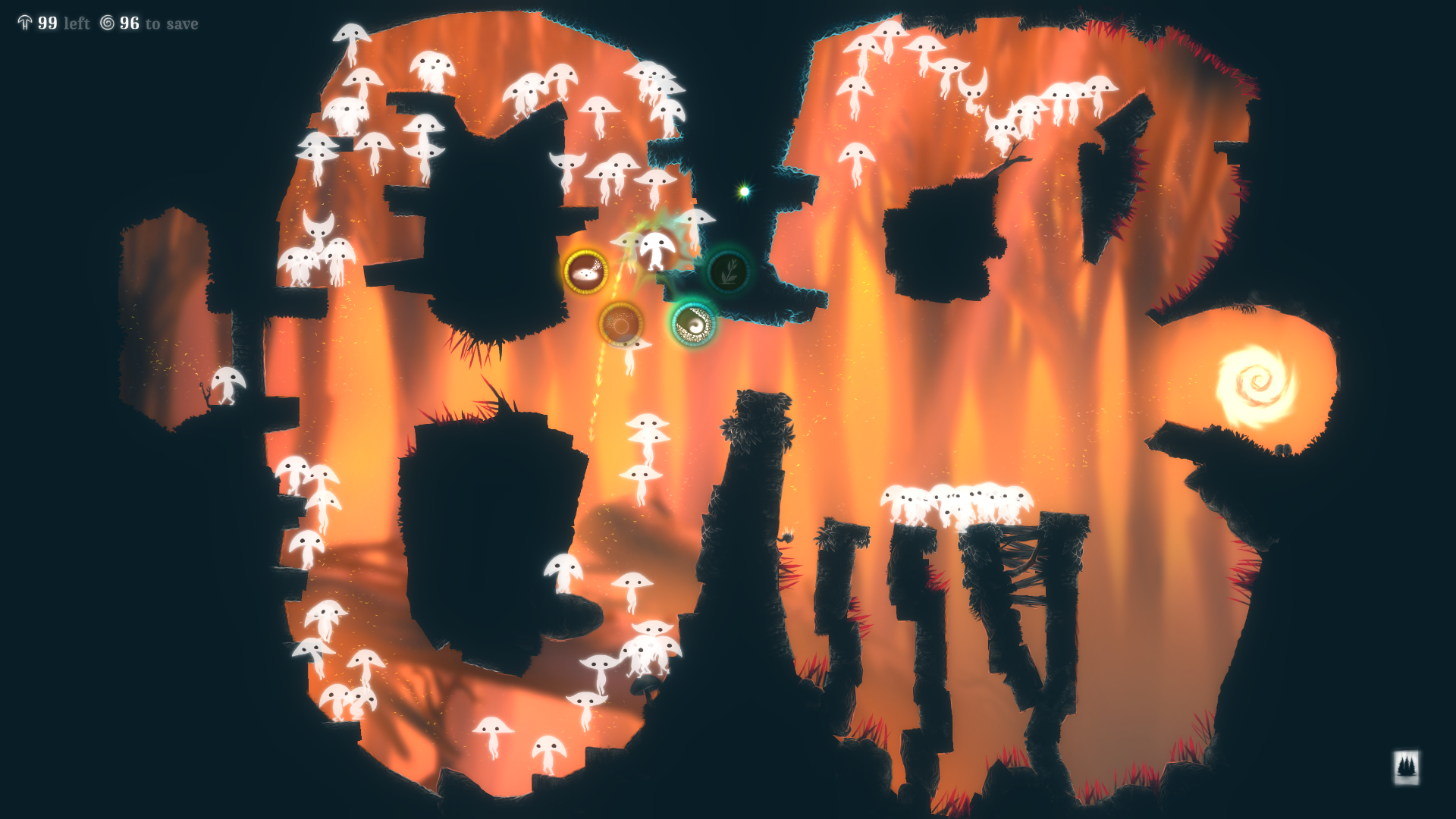
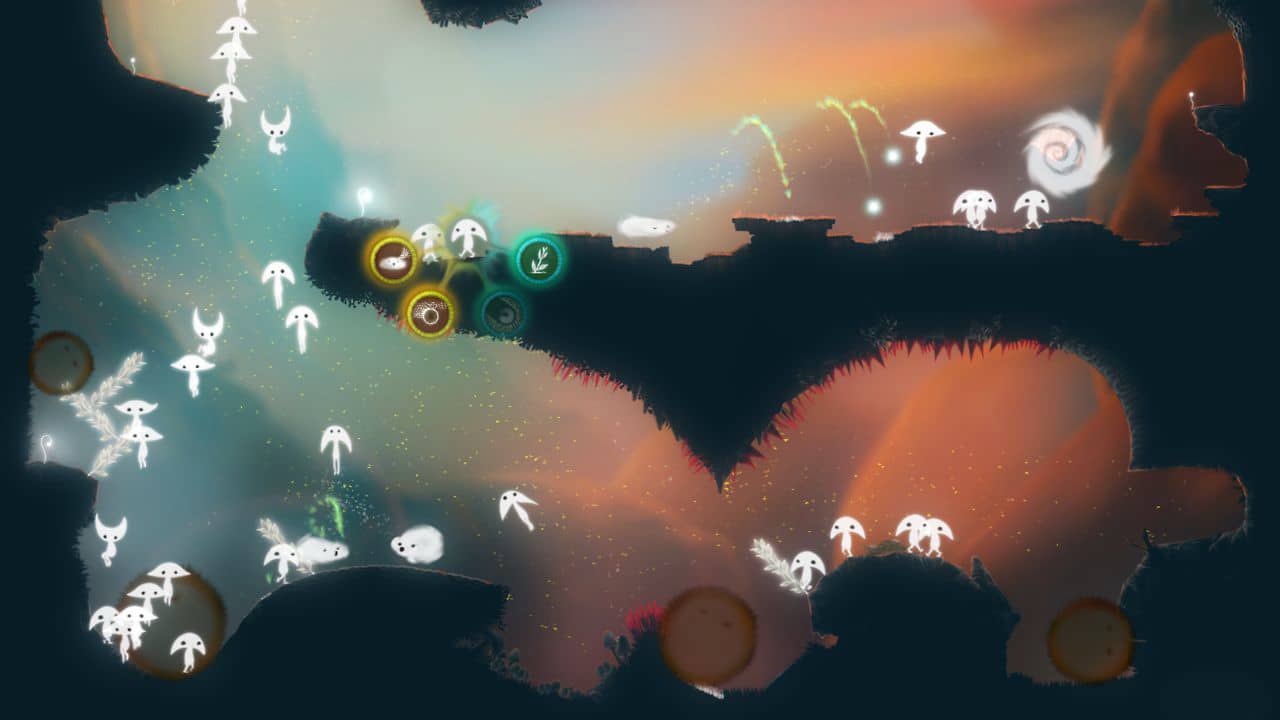
With our own tech, we can work more efficiently with fewer creative limits, since we don't have to spend countless hours trying to make an existing engine work the way we want to. Most other game engines are built around the idea of static level geometry and skinned 3D character animations. Everything in Future Unfolding is based on 2D animations. Our code is highly specialized and optimised to render all of the game's world as dynamic objects in 2.5D. Even the ground is made up of dynamic particles. This is profoundly important for the painted art style of Future Unfolding, which does not rely on 3D geometry for shapes. As a bonus we get to have soft edges everywhere.
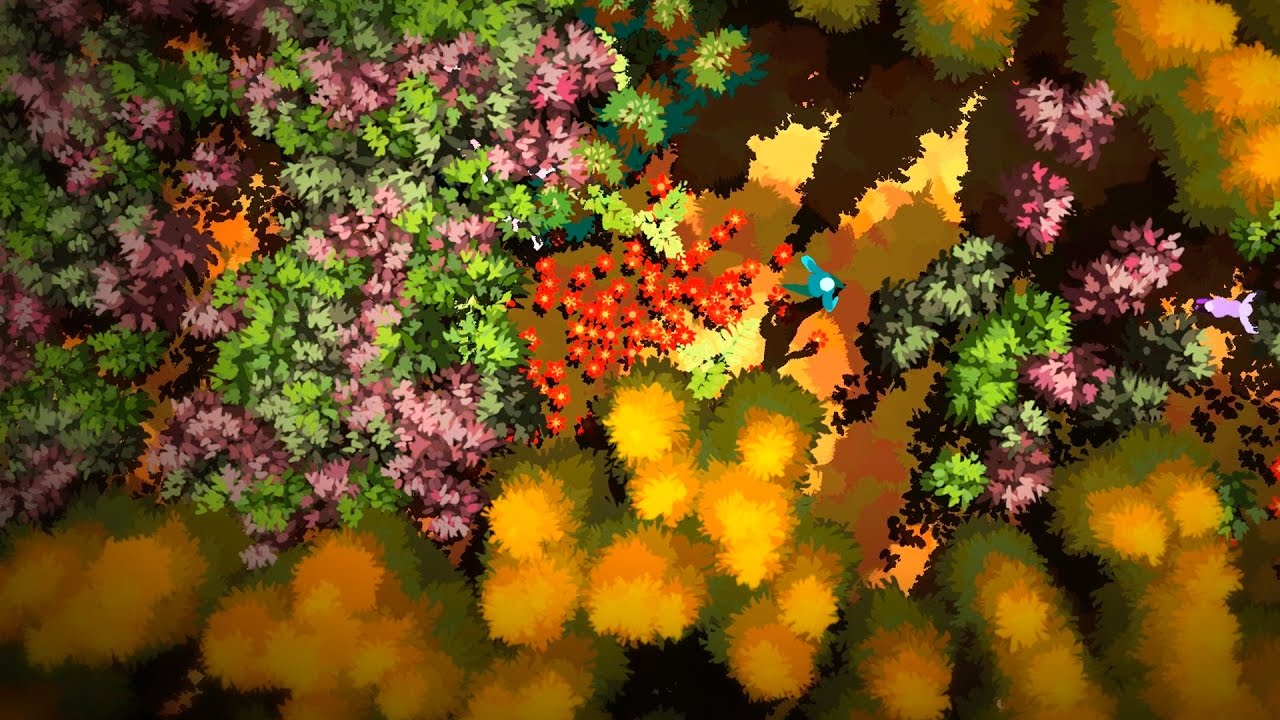
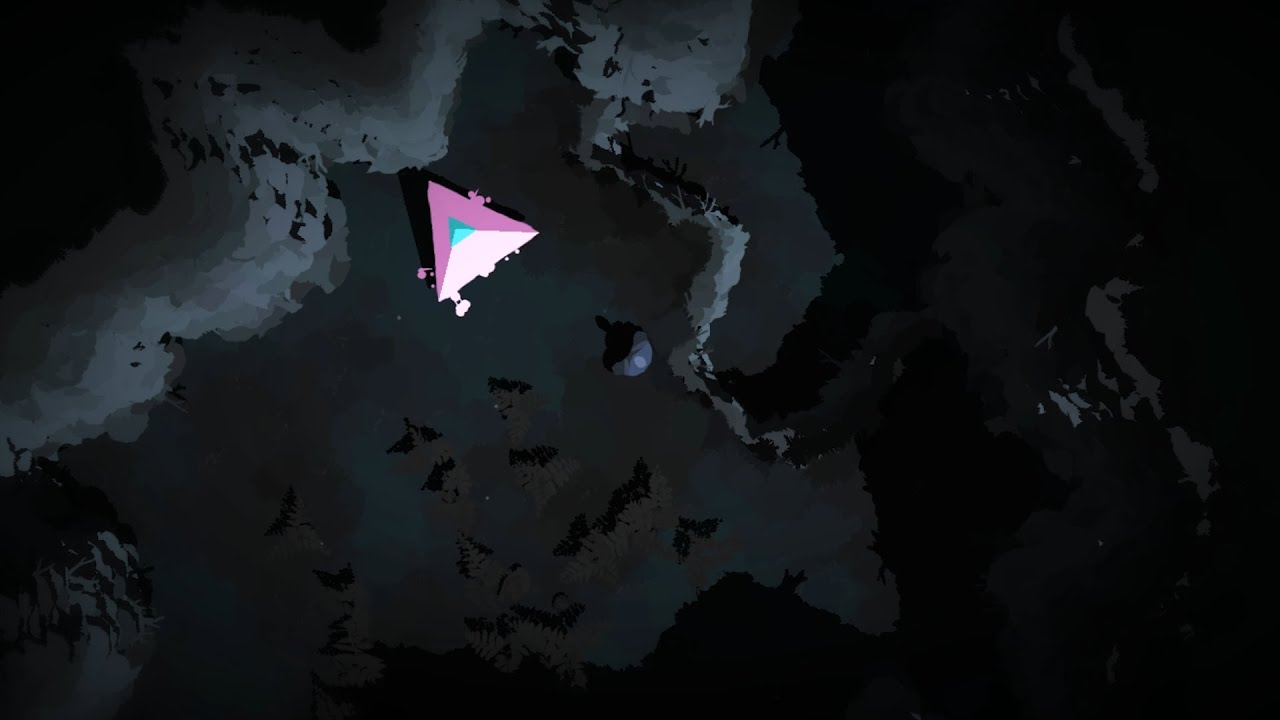
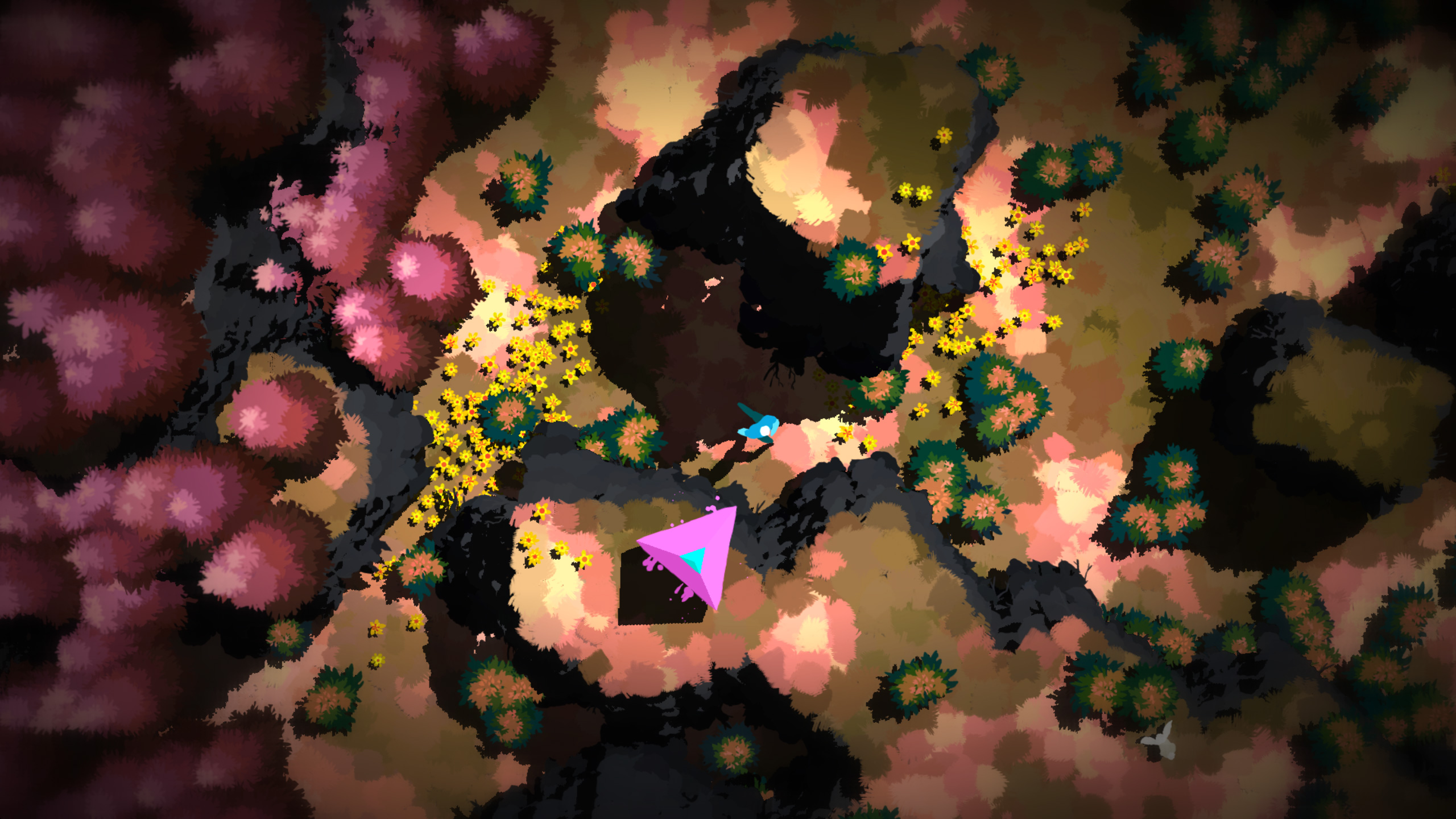
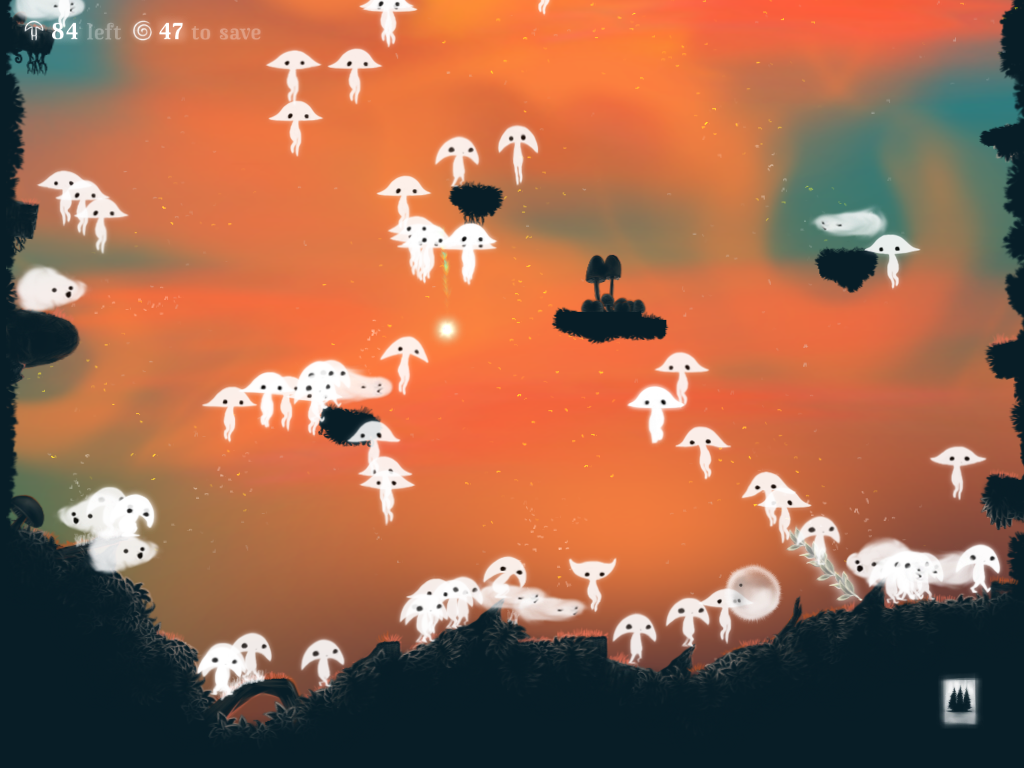
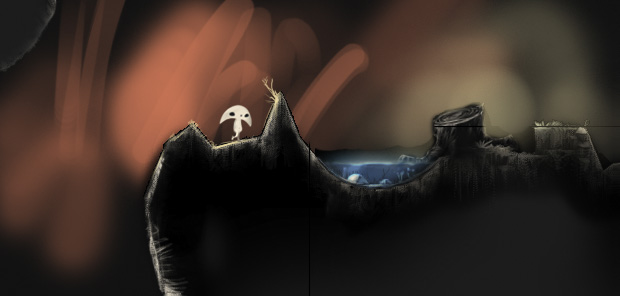
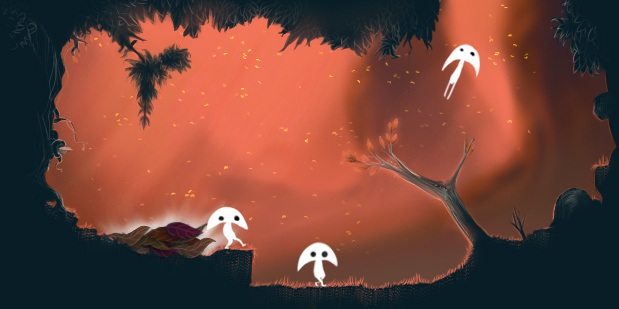
The world of Future Unfolding is composed out of thousands of dynamic objects
We sometimes call it a framework instead of an engine because it's really not something you could give to someone else unless they want to do exactly the same thing: Draw quads in the XY-plane.
If something crashes, we can always debug at the source-code level because it’s our own code. We know from other developers that working around bug and problems in an third-party engine can take up a lot of time and be very frustrating.
Lastly, we don't need to pay license fees for a game engine.
So, where's the catch?
The hardest part for us is to figuring out how to get the performance out of OpenGL we need. Because of our unusual art style, we have a huge amount of alpha resulting in expensive overdraw. However, since we only use as little functionality as possible from OpenGL, its makes it easier to finetune and optimize our code.
If you want to roll your own tech, focus on functionality that is specific to the game you’re making. If you end up creating a general-purpose engine, you might have been better off using an existing engine instead. Only add features that you need for your game right now. Don’t implement things that you think you might need in the future. The design of your game and its tech requirements are likely going to change over time.
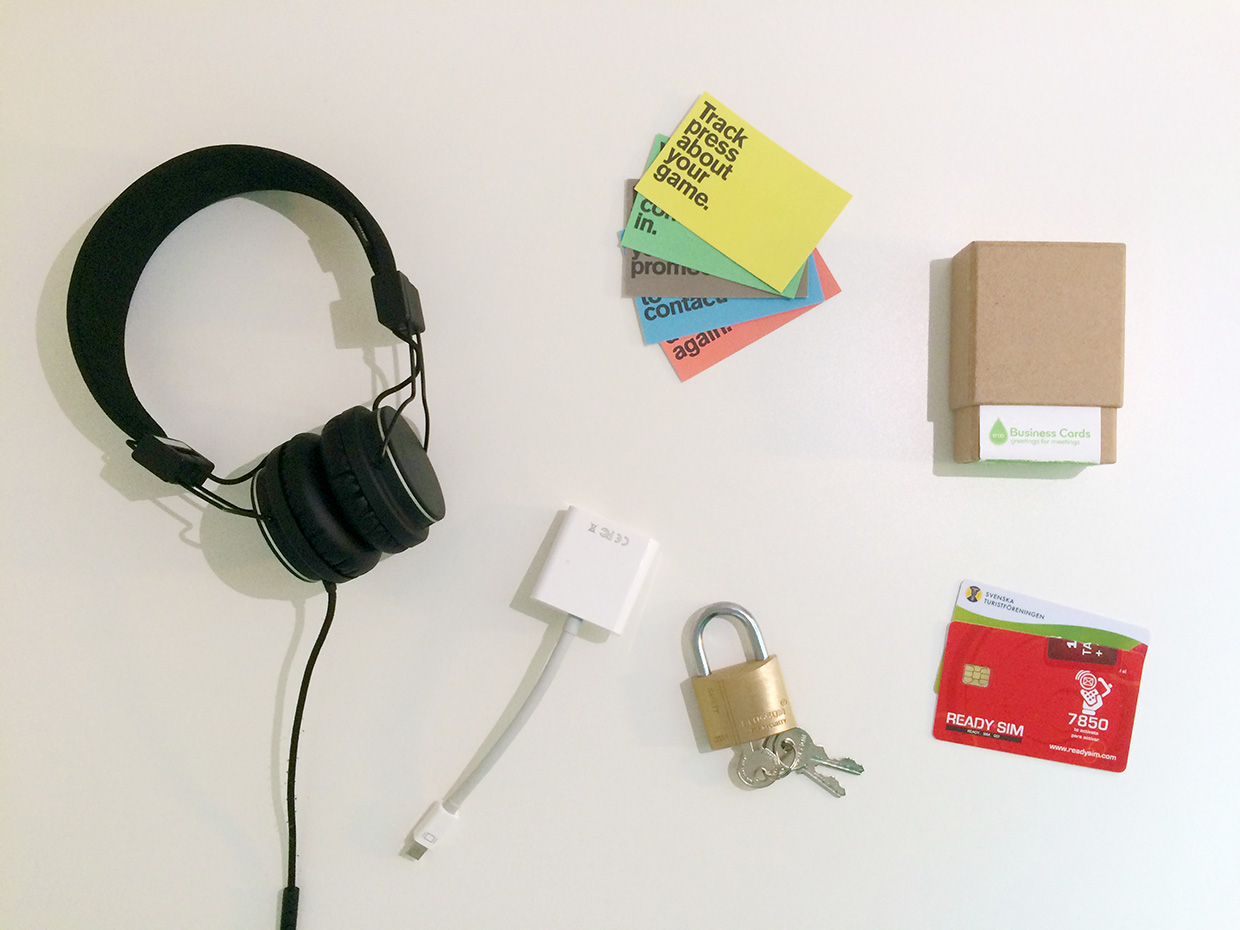
Pretty much every year we travel to San Francisco to attend the Game Developers Conference. When you go there for the first time it can be overwhelming, but even if you’re a regular it’s easy to forget at least one thing you should have brought. So this year, for the benefit of ourselves and everyone else, I wrote down a packing list.
Business cards
We usually order our cards at moo.com, where you can have several variations for the front of the card, while using the same back containing your info. This is a nice way to show off different visuals from your game. If you're unsure how many to order, err on the side of having too many than too few. You can always use them at another event.
Lock for hostel
If you stay at one of the hostels, they will ask you at the reception if you need a lock for your personal locker. Of course you don’t, because this year you remembered to bring the one you bought last year!
Hostel International Membership Card
If you are staying for around 10 nights, it’s usually worth it to get a yearly HI membership card that gives you a discount for your stay.
US SIM card
If you’re coming to the US from abroad, having a US SIM card during GDC is a lifesaver. Yes, there’s Wi-fi at the conference, but that won’t help you in the event-packed evenings. Being able to figure out where your team mates are just by calling them without paying huge roaming fees alone makes it worth it. For 35 USD you can get 1GB of data and free+text voice for 14 days from Ready SIM. You can send the SIM directly to your hotel, but make sure the order is made under same name as your hotel reservation. If not, there's a risk the hotel will discard the letter with the SIM in it. Alternatively, just order it in time to your home address. Also make sure to turn of automatic app updates on your phone or you’ll burn through your data in less then a day.
Laptop Display Adapter
I once had an important meeting where I was pitching our game in a meeting room with a really nice HD TV. Of course I didn’t bring my Display Adapter so I had to show it off to three people at the same time on my tiny MacBook 11”. Don’t make the same mistake. If you bring your laptop, always bring your adapter. (On a side note, you should always have one device with you where you can demo your game on. You never know who you will run into and when.)
Large Headphones
You often might run into the situation where you want to demo the game in a really noisy environment. If you have large headphones with you, you can accommodate for that at least a little bit. For obvious reasons of courtesy, don’t offer your personal, used in-ear headphones to anyone.
US Power Adapter
Buy this before your trip, or buy an overpriced one at the airport.
This means that we can focus on building the game in our intended scope. We want the game’s surrealistic world to feel full of life and variation, and with the additional funding we hope to achieve exactly that.
If you’re interested in applying for the MEDIA Programme, get in touch with one of the local Creative Europe Desks. They hold workshops that explain what’s important to know for the submission process and can help with any detail questions.
Last year we released Spirits on Google Play, which became our second most important platform. We caught up with Collin Jackson, the co-founder of Apportable to talk about the technical details behind the port, and why doing customer support in-house is so important.
Without giving away the "secret sauce", how did you port Spirits from iOS to Android?
We built a custom compiler (based on Clang) that compiles and runs Objective-C source code on Android. We also wrote our own implementation of the iOS APIs that Spirits and other iOS apps commonly use.
Many people think that we are converting Objective-C to Java or emulating iOS on Android -- this is not what we do! We are running the Objective-C code directly on Android using the Android NDK, which is why we are able to make our games perform as well on Android as they do on iOS.
We’ve recently released a free downloadable version of our platform called the Apportable SDK. The SDK makes our technology available to any iOS developer looking to get on Android without the hassle of rewriting his/her app.
Running Objective-C and supporting all iOS APIs correctly on Android, this seems a bit crazy at first glance. Is it?
Yes! It is very crazy, and we don't recommend that anyone else try it, unless they want to work at Apportable! In all seriousness, it is a huge technical challenge. We have had tremendous fun automating ourselves out of the way.
What was the most difficult and time-consuming part of porting Spirits?
In the case of Spirits in particular, we had to spend a substantial amount of time dealing with OpenGLES driver bugs on many different Android devices. We also had to improve our implementation of UIKit -- all of the menus you see in Spirits are made with UIKit, not OpenGLES! Happily, this is code that we’ve been able to reuse in our platform and SDK for powering many games and apps since Spirits.
You keep improving your software engine that ports iOS games to Android. How do you ensure new versions of your software don't introduce bugs or break functionality of other existing ports?
We’re always upgrading our platform to support the newest features on Android/iOS as well as fixing bugs and generally improving performance. As exciting as the prospect of perpetual growth is, we are also careful to make sure that the changes we introduce don’t destabilize games that have already been released to Android users. We keep the code powering the live games separate from the main development flow and only integrate changes that are necessary to fix technical issues or support new features that are specific to the game. Then, whenever an update is ready for release, we use a combination of our own and outsourced QA to make sure that the new version is compatible with a representative sample of Android hardware/firmware configurations. After release, we pay close attention to user reviews, analytics, and technical support requests to quickly catch any problems introduced by the update. We’ve built up a great deal of experience releasing various kinds of updates to games powered by Apportable and have developed a pretty good sense of what to watch out for.
What are the best and worst parts about developing for Android?
The worst part about developing for Android is undoubtedly the fragmentation. There are thousands of different Android devices, mostly all of which we now support, but that is only because we spent the time debugging device-specific issues. For example, many devices have their own opinion about what are called "lifecycle events" -- instances where the operating system forces the app’s behavior to change due to a particular trigger like pressing the device’s power button. If you don't handle all of these issues correctly, you can end up with bad situations, such as having a game's sounds playing while the screen is locked or the game is in the background. Our experience has exposed us to many of these troublesome idiosyncrasies, which we then fix and resolve in our platform.
The best part about developing for Android is interacting with the users. Android users really love the games our technology powers, and they are not shy about letting us know. Not only that, many users who encounter issues with a game on their device are happy to help resolve those issues, even going so far as to install special builds we send them to find out whether or not we've fixed the specific problem they are encountering. It's a real pleasure to help out such big fans of the games we work on.
How many different Android devices do you have available in your office for testing?
We currently have over 150 Android devices in our library representing around 15 different device manufacturers. The devices range from the original Motorola DROID handset of 2009 to the recent Nexus 10 tablet and Galaxy S4. Our inventory includes the most popular Android devices as well as those which are unusual in certain ways. Most of the devices are one-offs, but we also have 20 Nexus 7s -- they are great for development and popular among users.
When a customer has a problem installing Spirits on their Android device, Apportable is handling the customer support. Do you feel that doing it in-house allows you to see and fix problems quicker?
We offer end user technical support in our higher tier support plans, and there are definitely benefits for us. Bug reports from end users are our single biggest source of information about issues that could potentially affect all of the apps powered by our software. Once we fix an issue for a particular game, we can apply that fix to our platform and propagate it to other apps in development or maintenance.
Which ports are you most proud of? Not counting Spirits of course. :)
Osmos will always hold a special place in our collective heart, since it was the first game released on Android via our platform, but all of the other innovative games we’ve helped bring to the Humble Bundle and other stores are dear to us. We have more great indie games coming, too!
After the release of Spirits on Google Play you kept improving the port based on player feedback. In a marketplace with hundreds of different device models, is on-going development as important as getting version 1.0 out?
It is critically important to support apps once they’ve launched. If there is a major issue that affects a significant number of users, every day that the app is not updated can have a major affect on the game’s rating. We prioritize fixes for apps that have just launched or are currently being featured, but we also update apps to implement editorial feedback from Google and Amazon, or to add support for new APIs like Google Play Games Services and Amazon GameCircle.
We released our action-puzzle game Spirits on the iPad in late 2010. Over the next two years, we ported it to iPhone and Mac internally, and to PC, Linux and Android with the help of Tim Ambrogi and Apportable. For each port we spent a significant amount of time in getting the quality of the ports up and above the original version, supporting platform-specific features like Retina resolution or Steam Cloud. Reaching more players on different platforms helped our studio to be sustainable, and to be able to have some money in the bank while we work on our next game Future Unfolding.
*Other: T Store (2.4%), Indie Royale (2.2%), Amazon Appstore for Android (0.1%)
Total Revenue from November 2010 to February 2013
Visualization based on "Easy as (a) pie" script by Stephen Boak
We want to share our revenue per platform numbers with you since there are some interesting observations to be made – some going against common perceptions (e.g. Steam being the most important platform). The distribution of revenue amongst platforms looks different for every game, but we hope that sharing our numbers will give you at least one data point that might help you decide which platforms you should put your effort into.
After the split the platform-holders take, Spirits has made a total net revenue of 279987 EUR (approx. 366000 USD) to this day. To put the numbers per platform in context, have a look at the months (mo) in the pie chart that the game has been on sale on each platform. (We only count the periods which we have been already paid out for, which can differ by a few months depending on the platform.)
Given that the iPad version has been on sale for the longest period of time, it's not surprising it accounts for the highest amount of revenue. It's also priced at a premium of 4.99 USD and doesn't support the iPhone, which was more common in 2010 than it is now.
What's more surprising is that Google Play is #2 for us. This version is 2.99 USD and works on both tablets and phones. We were lucky to get a feature early on and temporarily changed the price to 0.99 USD during the feature. The saying that Android is not worth developing for compared to iOS does not seem to be true anymore.
Humble Bundle is an interesting one for us as well. We launched the PC, Linux and Android versions here, but it did probably not cannibalize Google Play and Steam sales by much. Looking at online discussions, Humble seemed to have helped getting the game to players who never heard about Spirits before. However, there might have been a perception issue with launching the PC and Linux version as part of the Humble Android bundle, and some players may have disregarded the game for being a port of a mobile game. What-if scenarios are hard to measure, but it's something we keep in our minds while developing our next game Future Unfolding.
Steam is a tale others have told before: Sale promotions make the majority of the revenue. However, nowadays a sale without any kind of feature can go very much unnoticed in the vast sea of great (indie) games available. Two things that helped us was being featured in a flash sale, and being included in a large indie bundle which found many buyers despite its relatively high price point. It's great to have your game on Steam to reach core gamers, but with 11.4% of the revenue it was not make-or-break for us.
At a lower price point (2.99 USD), Spirits on the iPhone made a bit more than a third of the iPad revenue. This was the easiest port to do. The work mainly involved optimizing the frame rate on older iPhone models.
Mac App Store was not huge, but worth more than we'd have thought. We got a good feature here and the fact that the game's visuals and polish make it a good showcase app probably helped here.
T Store might not be a common household name, but it has a significant Android market in South Korea. This is one of the few smaller deals we made that actually was worth the paperwork and localization.
Indie Royale was a nice bonus after having had the game on Humble Bundle. It also got the game on Desura, which a handful of players had requested.
So far, we've had zero visibility on Amazon's Appstore for Android. The slice on the pie would be too small for you to actually see it. This is another indication for us that putting up a good game on a store is not enough to actually sell anything.
With our revenue being spread relatively evenly among different platforms, going multiplatform was a strategy that worked well for us. It allowed us to get more out from our initial investment of designing and developing the game and to reach more people enjoying the game.
2012 has been busy and all about Spirits for us, but we have something new coming! Here's our squeezed-in-one-paragraph recap.
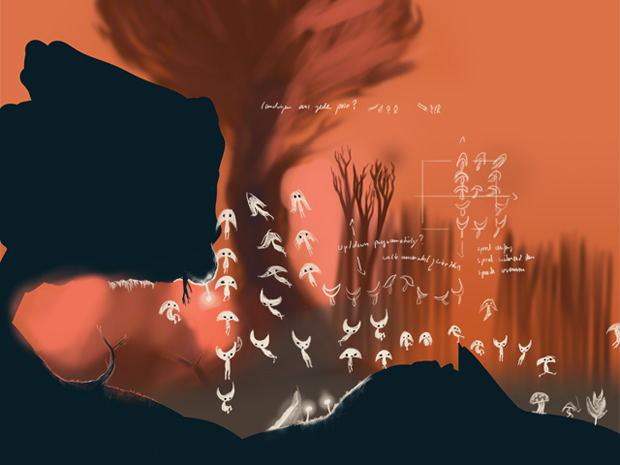
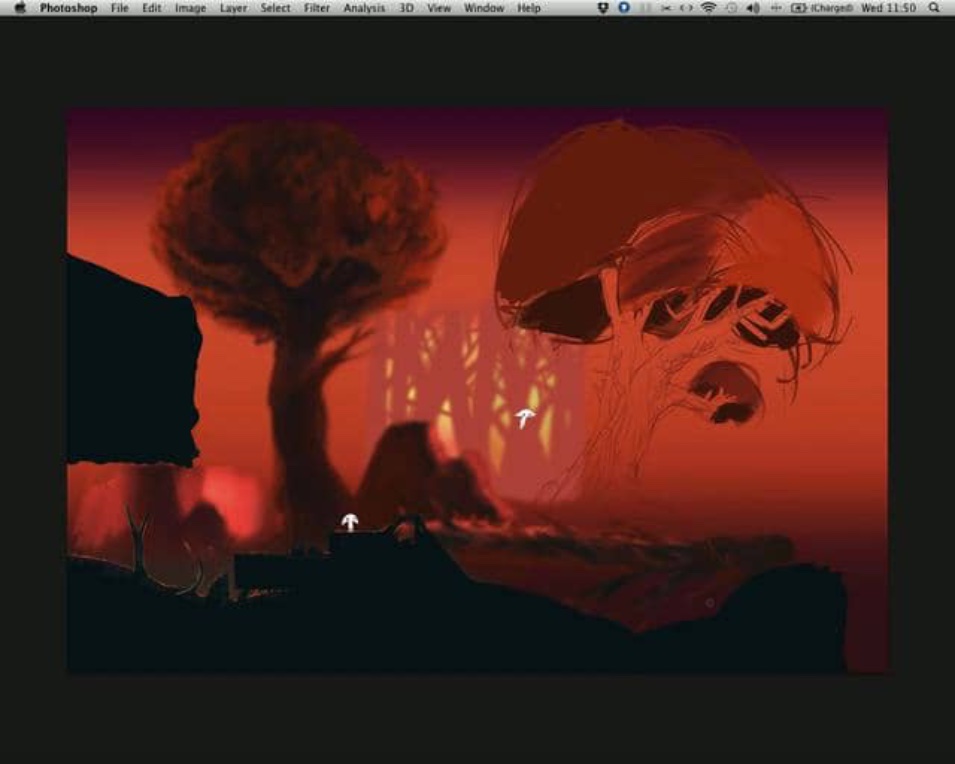
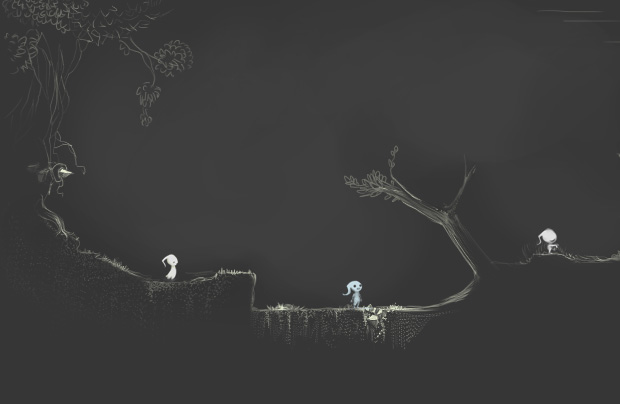
We run into #1 Spirits player Mads Johansen at Nordic Game Jam and hire him to design a few bonus levels. Spirits becomes a first-class citizen on the Mac with iOS Retina updates as a side-effect. We redesign our press kit, which inspires Vlambeer to make the useful presskit(). GDC as usual followed by a weekend at a friend's retro-futuristic house in the woods. Other activies include disc-golfing, running the Golden Gate Bridge and AcroYoga. Mattias and Andreas attend No More Sweden and make a little 4-player arcade digging game. Spirits comes to Windows, Linux (ported by Tim) and Android (by Apportable) via Humble Bundle and Steam. Kert Gartner produces a beautiful trailer. The box-stacking game Ordnungswissenschaft co-designed by Marek is shown at the Hammer Museum in LA, Spirits at f/ in Stockholm and hóPlay in Bilbao. We finally start working on the Adventure game idea we had back in January. The image above is very early work-in-progress, but we're excited to work on a bigger project again.
Spirits has been orange-lit and comes to Steam next Tuesday, September 4! It's 10% off for launch, so pick it up for just 8.99 USD or 8,09 EUR. The new version includes all the new levels by Mads, neat tech on the PC-side by Tim, 14 Steam Achievements from easy as pie to practically impossible, Steam Play (buy it once, play it on PC and Mac), cross-platform synching of save games via Steam Cloud, and the all-new 10-page digital booklet "The Art of Spirits" with previously unreleased sketches and graphics.
We're really proud of this release, and we hope you can see the amount of detail that we put into it. Enjoy, as always!
I'm a danish Software Engineer and I currently reside in Copenhagen, where I'm doing a Master of Science in Games. I love playing games of all sorts, and I especially love playing challenging games. My favorite beverage I would have to say is water, I like my H2O just as much as the next Waterboy. My current world rank in Spirits is 3rd with my iPhone 4. I was rank one for a long time, but after the new iPad turned up, a rival has shown up, unfortunately I haven't had the time to fight back yet. On the desktop version I'm ranked 13th with my speed run (2 hours and 30 minutes) from the launch day of Spirits for Mac.
You're currently doing a Master of Science in Games at the IT University of Copenhagen. What's it like there for you?
It's very busy. I work part time as a Software Engineer, while studying and doing hobby projects on the side. But it's a great environment for being creative and I get to do some interesting stuff with my programming skills, so I like it a lot.
When we ran into you at Nordic Game Jam you showed us some scores in Spirits that we didn't knew were possible. What's the best strategy to rank high in Spirits?
To rank high in Spirits you've gotta be persistent, very systematical and you've got to be able to see where you can optimize a solution.
We asked you to design a couple of new levels for Spirits. Without giving away any spoilers, what was your approach when designing them?
I wanted to make levels where there was a lot of room for different solutions, where the player could find many solutions, but had to spend some time to figure out the best one. I was also just thrilled to get to play around with the level editor and try out different things I had in mind when I'd played Spirits.
You knew Spirits very well from the perspective of a long-time player. How did your perspective change when you started to design levels for the game?
I had to put some of my player background behind me, because in the beginning I was very focused on how to solve the levels I made, and I thought it would be fun to have the sense that there was a lot of room for optimization, once you'd played through a level once. But I shifted a bit away from that later on to focus more on the puzzle side instead of the optimization/slack side. Getting the feel of a level just right is actually not that easy, especially when my feel was very focused on the perfectly optimized solution. So I had to try and think about what the player naturally would do in a situation and then I'd try to make that more puzzling.
On a scale from 1 to 10, how hard is it to get the perfect solution for the new levels?
In relation to the other levels in the game, I'd probably say around 8–9. But in relation to the World Rank #1 solutions of some of the levels in the game, these are probably only around 6–7.
You are the co-creator of LAZA KNITEZ!!, a local-multiplayer top-down arcade-game that won the Indie Sensation award at Nordic Game. What does the game play like, how did you come up with it and what have you planned for it in the future?
The game is like a crossover between Joust or Asteroids from the early 80's and Unreal Tournament / Quake. It is really fast paced jousting and shooting, combined with powerups and deathmatch gameplay, and all of that on one screen. The game has an arcade feel, and it really shines on a cocktail style cabinet, where players are moving around more freely and the atmosphere is more like the one you'd find around a fussball table. The air becomes electric and people are having a lot of fun.
The game was created as a student project in the course Game Design at the IT-University of Copenhagen, and we wanted to make a 4 player game that we could all have fun with (we were four people in the group). For now the game is free to play online on LAZAKNITEZ.com. We're talking about remaking the game as a non-flash game, and distributing it somehow, to let more players play it with their friends.
Where does your nickname and Twitter handle @pyjamads come from?
I wanted to have a funny handle that could be pronounced by anyone in the world, and still be personal and unique. So I just found a word where part of it sounds like my name "mads" pronounced "ma's", that word was pajamas/pyjamas (English/Danish), then I combined the two and got pyjamads.
PC or Mac guy?
PC guy, even-though I like the idea of the new MacBook Pro with that gigantic resolution.
What game influenced you the most in your decision to become a game designer?
I love playing games and having fun, so naturally when I found an excuse to begin making games, I just went for it. But any single game, that's a hard one, I mean over the years, the game I've played the most ever is Quake 3, and I loved the competitive elements in that game so much, that I really want to make games with those elements.
Tim, please give a short introduction about yourself. Hometown, pastimes, favorite food, current leaderboard position at Jamestown?
I’m Tim, the programming half of Final Form Games. As a kid I actually moved around a lot overseas. My parents taught at international schools, so I was dragged around from country to country until I went college (at which point I moved to the US). I love cooking, playing games, reading historical fiction, and, of course, making games. As to my Jamestown scores: my glorious records have long-since been obliterated by talented players like this.
We asked you to port Spirits over from the Mac to Windows and Linux. Could you go a bit into the technical details of that? What was the hardest part of porting the game?
Well, because the game was written for Mac, there was a fair bit of Objective-C code that needed to be ported to C++. Additionally, even though it was built on top of OpenGL and OpenAL, the game still relied on some audio and video playback functionality that was not cross-platform. So, I had to write some code to playback video and audio on both Mac and Linux. This A/V code took a fair bit of work, but I’m quite happy with the end result. Due to the generosity of Spaces of Play (to both myself and the indie community), I was permitted to create the audio mixer as an open-source library for all to share!
The other big challenge was getting the Linux port to play nicely across different distros. While I did some Linux development before for Jamestown, there is a huge amount left for me to master. Many thanks to Ryan Gordon (aka icculus) for his help getting the Linux port out the door!
You're based in Philadelphia, we're over here in Berlin. What was it like to work on the project remotely in a different time zone?
It was actually pretty easy, though I suspect this had a lot to do with Mattias’ talent for never sleeping! The Basecamp groupware that we used helped keep small tasks in sync, whereas Skype worked well for complex debugging and collaborative problem-solving. Ultimately, though email was the most extensively-used tool – there were times when Mattias and I would create a thread 30-emails long in a single day!
Soft or hard tabs?
Always soft tabs if I can – the trick, of course, is getting a group of programmers to agree to do the same. :)
You developed the frantic multiplayer top-down shooter Jamestown at Final Form Games. Do you see local multiplayer games making a comeback with indie developers slowly picking up the genre again?
Oh my, this is a sensitive topic, isn’t it? :) Because local multiplayer is usually orders of magnitude easier to create than online multiplayer, I expect many developers will be faced with the following decision: single-player-only or local-multiplayer? In the case of Jamestown, we knew we couldn’t afford to create online-multiplayer, so we chose to create local-multiplayer instead of nothing. I think it was the right choice - imagine the fun our players would have missed out on if we’d only created a single-player game! That said, it’s a risky choice, and I’ve seen several games docked a point or two in reviews because the multiplayer they did add wasn’t online-enabled.
What I really hope, actually, is that we will see a revolution within our wireless internet infrastructure (such as DIDO), enabling us to dramatically increase bandwidth and reduce latency. Coupled with cloud gaming systems such as OnLive, we would be able to implement online multiplayer using the same techniques that we currently use to implement local multiplayer. If that sci-fi reality should come to pass, it could open the floodgates to developers of all sizes being able to implement online multiplayer in their games.
Where did the "neo-classical" inspiration for the story and art style of Jamestown come from?
We’re often drawn to historical fiction because it helps to anchor a story within a familiar world, without sacrificing the freedom to follow our imaginations (no matter how implausible an idea may be). The old-school genre, old-school art, and historical setting provided us with an classical feel to the game. In the process of developing the game, we also explored modern game mechanics and science-fiction story elements, eventually ending up with something that felt classic, but was clearly a modern work. So, as a pretentious tongue-in-cheek allusion to the musical world, we decided to call it a ‘neo-classical’ game.
Jamestown is a very impressive debut game. What did you guys do before starting Final Form Games?
Before Jamestown, we worked in the game industry in San Francisco, CA. I programmed PC, Wii, iPhone and PSP games for 5 years, saving up money to found my own studio. My brother Mike did art, animation, level design and game design for 7 years at various companies prior to Final Form. My friend Hal (our third co-founder) worked at LeapFrog designing the database back-end systems for educational games and toys for children. Francisco (our composer) worked (and still works) on television and as a studio/concert performer.
What's your favorite development tool of all time?
Honestly, it’s got to be Visual Studio. Other favorites for cross-platform development are CMake, CodeLite, Python, and valgrind.
What's the best thing about Philadelphia?
I can’t pick just one thing! There’s so much to love: the cool people, the beautiful architecture, the culture and art museums, the beer, and, of course, the sandwiches. :)
Today Spirits goes truly multiplatform and comes to Windows, Mac, Linux and Android as part of the Humble Bundle for Android 3, alongside with indie classics Fieldrunners, Bit.trip Beat, Uplink and SpaceChem.
The game has been faithfully ported to PC and Linux with the help of Tim Ambrogi of Final Form Games, developer of neo-classical top-down shooter Jamestown. (If you haven't tried Jamestown's 4 Player Co-Op Mode yet, I encourage you to pick it up!)
The Android version has been developed in collaboration with Apportable, the team who brought Osmos from iOS to Android. It supports both phones and tablets and is available on the Google Play Store as well.
The Humble Bundle also includes a key for the upcoming Steam version of Spirits that supports Steam Play, Steam Achievements and syncing via Steam Cloud. We also threw in a bonus Art Pack including sketches from the development and a digital poster featuring all levels. Spirits is coming to Steam regularly shortly after the Humble Bundle campaign is over.
As topping on the ice, all versions of Spirits (including iOS!) now come with new, challenging levels by long-time #1 ranked player and award-winning game designer Mads Johansen. We ran into him by chance at the Nordic Game Jam in Copenhagen, and he showed us how to solve levels in a way we never thought was possible. Bonus tip from him: "Using the pause-feature is half the game."
A MAZE. Indie Connect 2012 is the first independent games festival in Germany and takes place in Berlin this week at April 26 and 27.
The festival wants to foster bold and experimental indie games and honors one of the 10 nominees with 5000 EUR (6500 USD) and a terrific looking trophy. In the long run the Indie Connect wants to bring together game developers with all kinds of disciplines and art forms that are related to games like chiptune music, game art, academic research, machinima, writing, media art, game development … and so on.
The festival director Thorsten Wiedemann is known for an interdisciplinary approach to games. He is responsible for heaps of events and festivals that pushed games out of their usual context like the A MAZE. United, A MAZE. Interact, the Global Game Jam Berlin (that took place in a night club) or the provoking Games Culture Circle where fine guests like Eric Zimmerman and Ralph Baer spoke already.
Although the festival is in its first year, the program is already impressive. Keynote speaker Jonatan Söderström (Cactus) opens the conference on Thursday with a talk about the consequences of success for indie games. On Friday developer and researcher Douglas Wilson (best known for his smash hit Johann Sebastian Joust) will 'sing' an ode to Proteus, followed by the guys from Vlambeer (Super Crate Box) who will talk about 'Sensible Nonsense'.
Two days of talks, workshops, a pretty award show and Berlin-style parties are included for an affordable 60 EUR fee (78 USD). You can get your tickets here. See you there!
Not an early adopter? Looking to give a great game to a friend? Until Sunday you have the chance to grab Spirits on the Mac App Store at half the price.
It still looks gorgeous on whatever Mac you have. And it's a delight to play. In fact, good game get! named it “one of the best contemporary puzzle games today”.
It's yours for USD 4.99 or 3,99 EUR only.
Know someone who'd like Spirits? Please share the news.
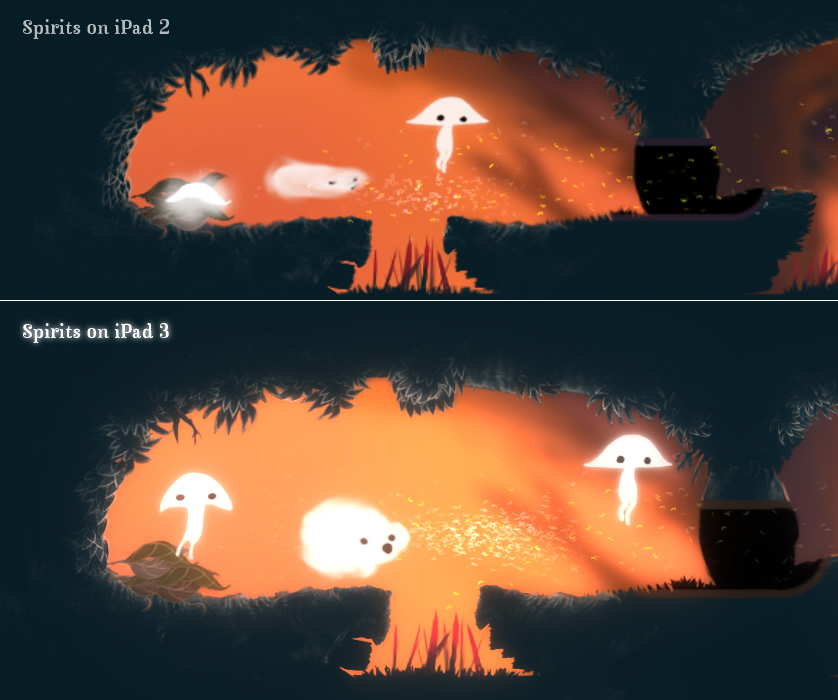
The last months we have been working on porting Spirits to the Mac, redrawing all graphics to work in practically every display resolution up to an iMac 27". During that time, we kept hearing the same rumours again and again that the next iPad will feature a Retina Display with double the resolution of the original iPad. So we decided to back-port our new HD graphics from the Mac to the new iPad.
Our goal is to get this Retina update to Spirits for iPad on the App Store as soon as possible. We think it's going to look pretty neat.
With Spirits being out on the Mac App Store, we made three new desktop wallpapers for you. They are in the standard aspect ratios: 16:9, 16:10 and 4:3 up to a resolution of 2560 x 1440.
Oh and in case you missed it, we still have iPad and iPhone wallpapers in stock.
We have been Mac fans for years, so it's no wonder we ported Spirits to the Mac first.
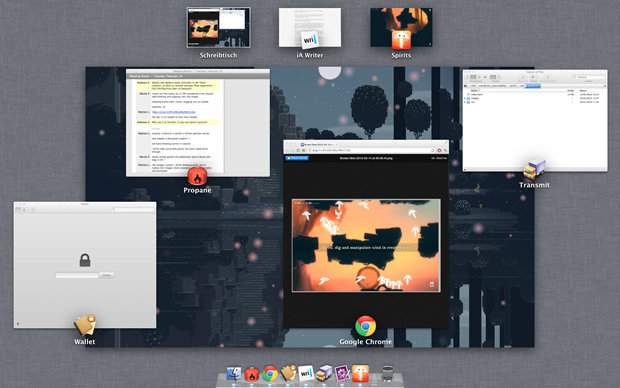
One of the things that's great about the Mac is its ecosystem of native apps that focus on user experience and feature a tremendous attention to detail. Here's a selection of our favorite apps that help us being productive and getting things done everyday.
Since we work from three different cities we practically live in Campfire. It's a web-based group chat system that doesn't get in your way and works great both in real time and asynchronously. Best enjoyed together with Propane, a native OS X client for Campfire.
Whenever we share a screenshot on Twitter or Campfire, we use CloudApp. Drop any file on its toolbar icon and press CMD+V – you just pasted the file url right where you want it. There is no step 3.
From YouTube to iTunes Connect, we literally have dozens of accounts. Wallet makes sure we keep our credentials encrypted in a central place, so we don't have to use "god" for all our passwords. Syncs between Mac and universal iOS app via Dropbox.
We use Writer to write most of our copy, be it a press release, a submission to a festival, a blog post or our latest newsletter. It works perfectly and distraction-free on Mac and iPad and syncs effortlessly between the two via iCloud.
We go to Transmit to keep our website updated, edit files on the fly, login to S3 to access our database backups and manage file permissions in our Wordpress install. Simply the most solid FTP tool out there.
For coding we fire up TextMate – the canonical text editor on Mac. Even though its successor TextMate 2 has been in development limbo forever, the “old” release still excels at coding practically any language with its flexible and elegant bundle system.
If you keep forgetting how you named your files or where you downloaded them to, Fresh is perfect for you. Press a keyboard shortcut and it will show you files that are new, changed, recently opened or stored in Fresh by you.
The first reviews for Spirits on the Mac are in!
Here's a selection of the ones we liked the most:
“Spirits is a captivating title that is clearly one of the best contemporary puzzle games today, whether it’s on your iOS device or your Mac.”
–Kyle Wallace, goodgameget!
“Perhaps this is the video game community’s chance to atone for all those lemmings they killed back in the 90s? 85/100”
–Charles Battersby, indiegamemag.com
“The artwork, user interaction and user interface have been scaled to the Mac perfectly. The attention to detail to artwork is immense, but the attention that has been put in to making this a truly great Mac app is even greater. 5/5”
–Jack Griffiths, Enoda
“Beautiful. Cathartic. Make sure to set an alarm before you play. Much like Osmos, a quick-to-learn game with stunning ambience that players will lose themselves in. 5/5”
–Jigsaw Forte, User review
“Great gameplay, gorgeous artwork, beautiful effects – overall a really immersive game. 5/5”
–hakimel, User review
Lately it has been pretty quiet on this blog. We have been busy getting Spirits ready for the Mac. Being Mac users for years, our aim was to simply do the best port we could. We completely redrew all graphics by hand, so that they adapt to any resolution up to 2560x1440 pixels. Believe us, it will look razor-sharp on whatever Mac you might have. (You won't even have to go the settings screen.) Add multi-touch trackpad support and native fullscreen in Lion, details you'd normally find in Mac productivity apps. Heck, Spirits is probably the only game that lets you use Mission Control while running.
We think all Mac games should be like that – not second-class ports released years after the PC version.
We've also taking your feedback into account and added a fast-forward feature that you can use whenever you want. (We're looking forward to your speedruns.) And, there is a new feature that let's you share your level solutions on Twitter.
So, that's Spirits on the Mac. It's coming to the Mac App Store on February 15 at an introductory price of USD 7.99 (5.99 €) for the first two weeks. The regular price will be USD 9.99 (7.99 €).
One year ago Spirits for iPad was released on the App Store. To celebrate we're throwing a little party with friends, cake and … an anniversary sale! It's 99 cents on iPhone and iPad until November 11 ends. Bring your pals!
Our friends at McSweeney’s asked us to help with the development of the iPad-exclusive comic Touch Sensitive by cartoonist Chris Ware. It's available today for 99 cents as an in-app purchase inside the latest version of the McSweeney’s app. The app itself is now free and comes with a one-month subscription to the Small Chair, a weekly selection from all branches of the McSweeney’s family.
Here's what McSweeney’s says about it:
In the briefest of flirtations with non-corporeality in this, his first (and likely final) iPad-only comic strip, our otherwise normally corporeal cartoonist and former McSweeney’s guest-editor Chris Ware attempts to address how, in some relationships, the act of touching seems to shift over time from that of affection to aggression. Chock full of his trademark constipated drawings and strained, overwrought text, the reader will also be pleased not to afterwards find him- or herself laden with a pamphlet or book to discard the next time he or she changes apartments, homes or relationships; like the 99 cents that instantly vanishes from one’s bank account upon purchase, all 14 speedily-swipable digital “pages” with their tucked-away animations and mildly disorienting transitions may easily be wiped from one’s computer’s memory with precisely the opposite degree of difficulty which one simply cannot forget that night of screamed obscenities at one’s (now ex-) girl- or boyfriend. (Please note, however, that all 99 cents and the rights attendant thereto remain, in perpetuity, the sole property of McSweeney’s and its satellite concerns.)
Touch Sensitive is a comic and unlike the other e-books in this store. It was crafted specifically for the McSweeney’s app and is available only in iPad format.
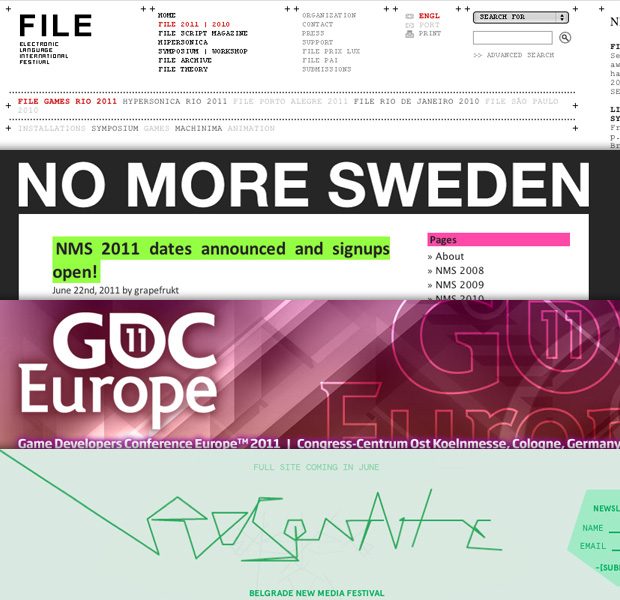
Long time no see! Be in one of the following places to hang out with us for a strong cup of coffee, two bottles of beer or an ad-hoc TRI-TRI-TRIOBELISK tournament. (Disclaimer: Spirits will make the trip to Brazil without parental chaperonage.)
July 18 – August 21 2011
Spirits for iPad will be exhibited at FILE Festival that will take place at the SESI Art Gallery, São Paulo, Brazil.
August 5 - 7 2011
Andreas will attend No More Sweden which this year is happening in his adopted home in Stockholm, Sweden.
August 15 2011
Mattias and Marek will give a presentation at GDC Europe about how visual art influences perception of game mechanics, and how visual design and game design can interact.
September 16 - 18 2011
Mattias and Marek will speak about the importance of having a strong connection between visual art, code and game mechanics at the Resonate New Media Festival in Belgrade. (Backed up by Andreas as best boy electric.)
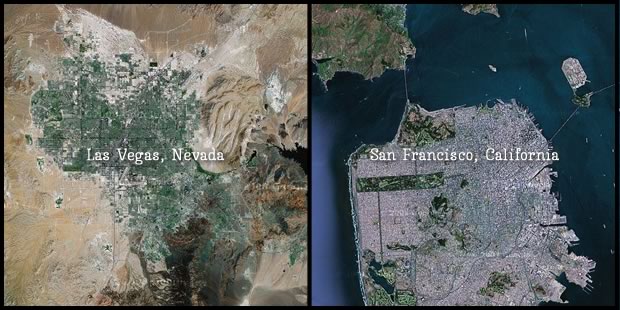
We're escaping the cold weather over here in Berlin and Stockholm and take the trip to Las Vegas tomorrow. Why? Because Spirits got selected as a finalist at the Indie Game Challenge! As if that would not be exciting enough, there are some amazing games nominated such as last year's IGF winner Monaco to name only one. Make sure to check out all finalists and if you want to make us happy, vote for Spirits!
In other news, we'll also attend GDC this year where Spirits got an IGF honorable mention in the "Best Mobile Game" category. Being 37,5% Scandiavian, we'll also make a small contribution to the KILL SCREEN VS SCANDINAVIA party during GDC. The party is run by the crazy folks from Copenhagen Game Collective, so you REALLY don't want to miss it.
If you happen to be at DICE in Las Vegas or at GDC in San Francisco and would like to meet up with us, just write us a mail. We're looking forward to see you there!
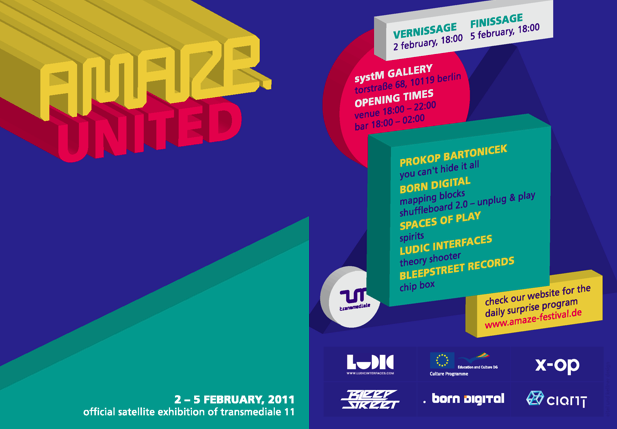
If you are in Berlin come and play Spirits at the A MAZE United exhibition, which takes place at Torstrasse 68 in cooperation with the Transmediale 11. We will be at the gallery on Wednesday, Friday and Saturday. The exhibition is open 6 – 10pm from February 2nd – 5th.
From the A MAZE. website:
“By combining courage for experimentation and joy in gaming, A MAZE. celebrates the convergence of computer games and art. A MAZE. plans to unite people via interaction, light and movement. The four-day event A MAZE. United at systM gallery shows an intimate selection of works, which are part of the future playground. In cooperation with Born Digital, an electronic art collective from Utrecht, Ciant the International Centre for Art and New Technologies in Prague, and Ludic Interfaces, a future European Masters programme, it will bring you closer to the magic of video mapping, audio visualisation and playful interaction betwwen knowledge and passion. systM gallery, a well-know venue with a regular changing and interdisciplinary arts programme, will host the event.”
Sometimes, other people are much better at explaining your work then yourself. Here's some of our most favorite reviews of Spirits, written by players on the AppStore. (Partially shortened for brevity.)
“Beautiful visuals, a wonderful sound track, and really innovative puzzles combine to make one of the best puzzle apps available on the iTunes store. Fans of Osmos will find the same atmosphere, and the same type of sensibility that made that game so different.”
“Didn't like the graphics nor the concept at first. But it grew on me. Amazing puzzles. Disorienting at first. Saving spirits? Spirits sacrificing themselves? The beauty of the design becomes apparent as you go on. Challenging. Then it becomes kind of fun saving the little spirits. Hard to put down, as with all great puzzle games. 5 stars.”
“A truly innovative game with clever puzzles and so many beautiful details.”
“Great design and super smooth play, it's great to see the Spirits make it to the iPad! The game has real grace and gets you really hooked on its little intricate world. Highly recommended!”
“It's one of those games where you want to hug your iPad. Very atmospheric, great gameplay, unique graphics!”
“This game is currently my favourite. It has a calm, hypnotic elegance that suggests it was a work of real love.”
“You have to think quickly, but this is no twitching reaction type experience and there's a great feeling of satisfaction seeing your train of spirits make it home. And that's the payoff: while many puzzles rely on the player suddenly "making a great shot", here you need a great plan. Your reward is seeing it being carried out.”
"Tricky … yet very peaceful. Extremely well done.”
"A really intriguing game different from all the other games.”
We are happy to get so much positive feedback. Thanks to everyone who wrote a review!
In the last weeks we were busy with getting Spirits on the iPhone and making sure it's optimized for the device. On Wednesday the 8th of December we will finally release Spirits for iPhone and iPod touch for $2.99. It will be a separate app with all 40 levels from the iPad version, including the same great music and graphics that will look even nicer if you have a Retina Display. Because the screen estate on the iPhone is smaller we have added the ability to zoom out more. This enables you to get an overview of the level you're playing to plan your strategy, and then zoom in again to see more of the details.
We are extremely happy with how the iPhone version of Spirits came out and think it was well worth the extra work. We're looking forward to get your impressions!
Everyone who loves the music in Spirits will be happy to hear that the soundtrack composed by Martin Straka is now available on Bandcamp. You're free to pay whatever you want for it, with a minimum price of $3 for the complete album. As always, you can pick your favorite audio format (MP3, ACC, Ogg, what have you) when downloading the score.
Martin has been quite prolific in the last years creating the soundtrack for various indie games, from Understanding Games to Trauma, which was nominated for the IGF "Excellence in Audio" Award. He's also up for new game projects, so make sure to get in touch with him if you need music and SFX for your next game.
Today is a special day for us: Our second game Spirits for iPad is available on the AppStore today! It's yours for USD 4.99 (or 3,99 EUR) and if you ask us, it's worth every cent. Some people think so as well:
“Striking art and innovative gameplay makes Spirits the belle of the Sense of Wonder Night ball.” –The Escapist, Fintan Monaghan
“Where Spirits really innovates is in its look and feel. When the wind physics start to do their thing, the experience is pretty magical.” –TUAW, Mike Schramm
“Spirits is an outstanding blend of puzzle and strategy.”
–DIYgamer, Arsen Nazaryan
“There is so much attention to detail in this game that once you have finished it you will want to play it all over again.” –CreativeApplications.net, Filip Visnjic
When we started to work on Spirits we somehow thought we can develop the game within one month. Looking at it today after one year of work, we're more than happy that we gave the game the time it needed. We are immensely proud of the result.
A huge Thank You to our beta testers and everyone who supported us. It's probably never been a better time to be an independent game developer and we are thankful to be part of such an inspiring community.
Also – Mom & Molly, Happy Birthday!
PS: You can find more information and screenshots for Spirits on our promotional page.
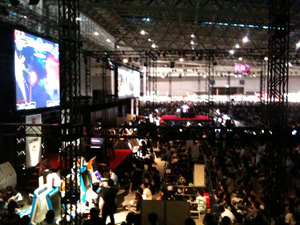
The recent weeks have been extremely hectic for us. In september Spirits was presented at the Sense of Wonder Night Event at the Tokyo Game Show, and last week we returned from IndieCade in LA where Spirits won the award for “Best Aesthetics”!
We had a great time in Tokyo and it was exciting to meet both local developers like the Nigoro team and some of the international crowd that was there, such as Evan Balster (infinite blank), Tyrone Rodriguez (Nicalis), Lea Schönfelder and Gerard Delmas (ulitsa-dimitrova), and Adam McLard (Origo Games).
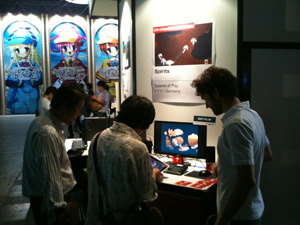
We showed Spirits in the SOWN booth at the Tokyo Game Show - it was the first time the game was shown in public and we were quite nervous. But people enjoyed the game, and we received tons of feedback that help us improve the play experience even more!
At IndieCade we got the opportunity to meet with some great indie game developers such as The Copenhagen Game Collective (B.U.T.T.O.N), Eddy Boxerman & Andrew Nealen (Osmos), Terry Cavanagh (VVVVVV), Gaijin Games (BIT.TRIP.RUNNER), Steph Thirion (Faraway), Ted Martens, Guy Lima, Jr. (Continuity), Paolo Pedercini (Molleindustria), and many more!
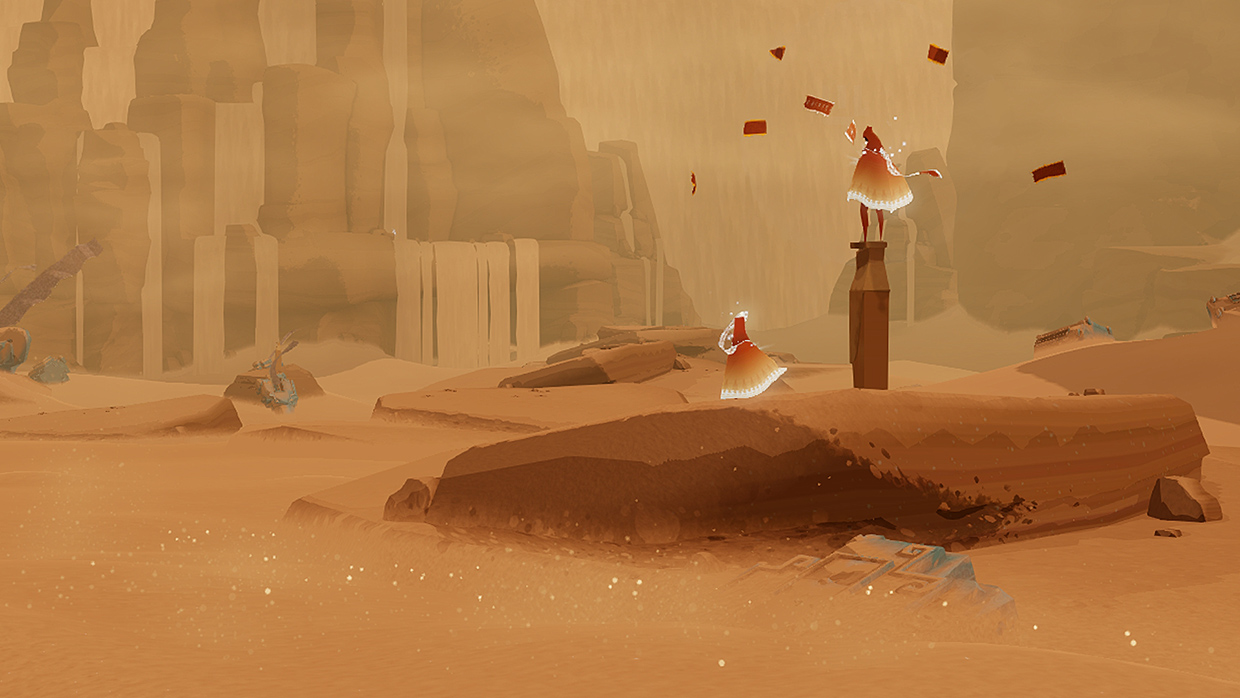
Robin Hunicke from thatgamecompany invited us to play-test their work-in-progress game Journey. The stunning visuals and mystical gameplay made a deep impression on us and kept us talking for days afterwards.
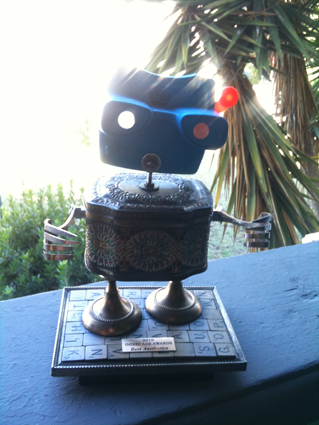
The absolute high point of IndieCade was of course the awards ceremony were Spirits won the award for "Best Aesthetics". We were extremely honored by this considering the tough competition from titles such as Limbo, BIT.TRIP.RUNNER, Sixteen Tons and A Slow Year.
Overall IndieCade was an incredible festival, and we will be sure to go back there next year!
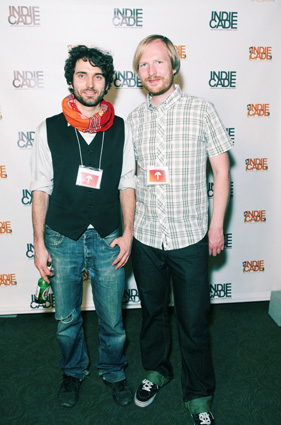
On the left, our awesome award. On the right Marek and Mattias in a photo by Mimi Haddon.
Spirits are shy beings. Make a first careful contact with them by saving these wallpapers on the iOS device of your choice. Be nice to them and more Spirits will follow soon.
If you watched our Sense of Wonder Night or No More Sweden presentations, you already got a glimpse of Spirits in motion. For everyone else, here's our first teaser video of the game, showing the iPad version. Enjoy!
Mattias and Marek will soon leave Berlin to present Spirits at the Sense of Wonder Night in Tokyo and then later at the IndieCade Festival in Culver City, California. This is the first time we are going to show Spirits to a larger audience, so we're really excited about this. We feel extremely honored to be selected among so many other creative independent games. Our sound designer Martin even got nominated for two games at IndieCade, the second nomination being for Krystian Majewski's adventure game Trauma. To round off the news we have made a nice promotional page for Spirits where you can see a handful of new screenshots of the game. Expect a teaser trailer to follow soon.
We already gave you some looks behind the scenes of the development process of Spirits. Today, we'd like to show you some screenshots from the actual game.
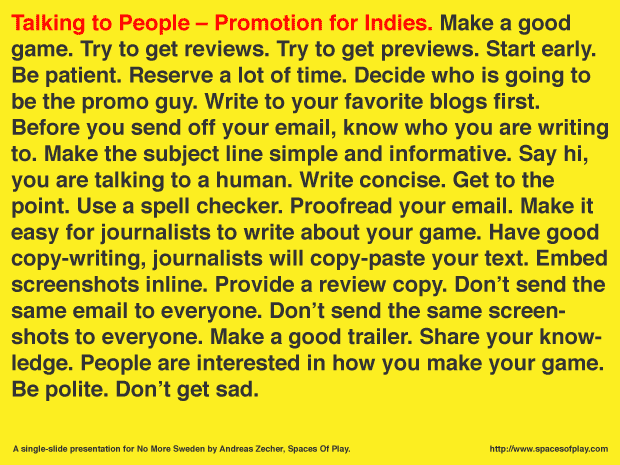
Mattias and me attended No More Sweden in Skövde last weekend. The game jam is in it's third year and this time people where encouraged to give presentations about current projects or things they care about. I really liked the new format – it was great to see what everyone is working on. We gave two talks as well: Mattias shared the game design process of Spirits and I talked a bit about Promotion for Indies (see slide above). The whole game jam including the talks was also live-streamed and can still be watched online if you missed it. We also uploaded some pictures on Flickr.
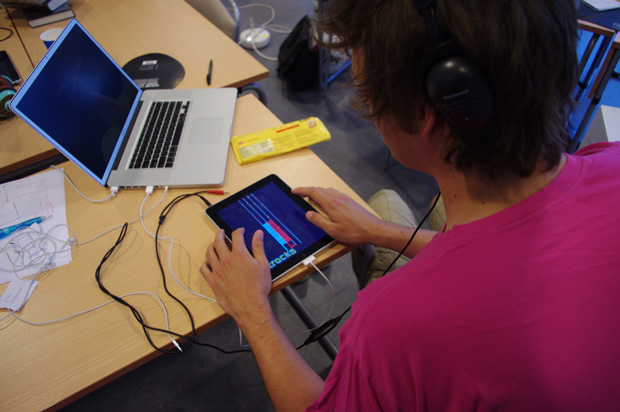
Between working on the Spirits high-score backend and preparing a demo video for Sense Of Wonder Night, we also managed to make a simple prototypish music puzzle game for the jam, which Martin Jonasson is playing on the photo above. And it won the second place in the Most Interesting Use of Sound/Music category.
Thanks everyone for a great weekend and hope to see you next year!
My friend Andreas asked me in 2006 if I‘d like to compose the music for Understanding Games. At that time I had little experience in producing soundtracks for video games. Even so, the collaboration for this project worked really well and I ended up doing the sound design for two further projects; Mr. Bounce and The Black Forest.
In 2010 I got contacted by Mattias from Spaces Of Play. He asked me if I‘d like to produce the music and sound effects for a new Lemmings-like iPhone game he was working on. I said yes right away.
Our workflow with Spirits looked something like this: Mattias and Marek told me about the ideas they had in mind and gave me some examples to listen to. They also had some first graphical sketches about the game.
We agreed on doing some kind of contemporary instrumental classical score for the game. That sounds a bit diffuse, doesn‘t it? To be more precise, we wanted to create a poetical, melancholic, and slightly spooky atmosphere using orchestral sounds.
Still not clear enough? I know from my own experience that talking about music and atmosphere in music can often be very difficult and unsatisfying. There is a high risk for misunderstanding in talking about music and agreeing on a musical characteristics during the composition process can become tedious. Because of these problems it‘s very pleasant for a Sound Designer if the client trusts his work and judgment. With Spirits I was lucky to receive this kind of trust.
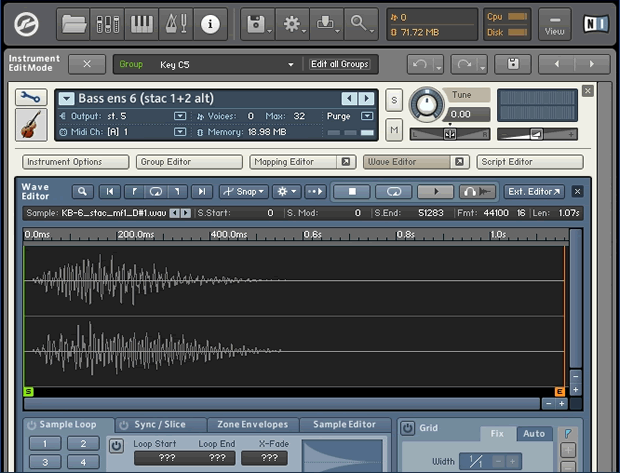
I started to sketch out melodies and harmony patterns on the piano and refined them in Steinberg Cubase 4. For the instrumentation I used the vast (over 33 GB) Komplete 5 library from Native Instruments which allowed me to fine-tune the characteristics of the instruments in a very intuitive way.
Marek provided me with videos of specific scenes in the game which made my work feel like composing for a silent movie: I‘m the conductor and together with the orchestra I‘m watching the scenes and spontaneously set them to music.
I decided to assign the "drummer" in my virtual orchestra for a major part of the sound effects. Every action in the game should be made audible by the sound of a percussion instrument that best matches the characteristic of the action. For example when building a bridge out of leaves, the player can hear the leaves rustling. This sound is created by a rattle shaking. I used a similar approach to sound design with musical instruments in Krystian Majewski‘s Trauma.
I regularly uploaded my music patterns to Basecamp so the other team members could review them and give feedback. Mattias would put the sounds into the game so we could play-test how well the music and sound effects fit. After several iterations we ended up with three nine-minute tracks each consisting of three varied parts which slowly build up.
For the mixing of the tracks I used the UAD-2 Solo Neve DSP card which features an excellent emulation of the Neve 88RS Channel Strip and Neve 33609/SE Compressor. For the mastering of the sounds I went to the studio of Andreas Schorpp in Karlsruhe where he works with high class analog equipment which allows for a much better result compared to home-recording equipment.
Martin Straka works as a sound designer since 2005 and lives in Karlsruhe, Germany. You can listen to his work at his website or follow him on Twitter. Many of his video game soundtracks are also available on Bandcamp.
Watch me paint an art asset for Spirits in this 8 min video. For the very first time you can also hear our game soundtrack in this video. It's composed by Martin Straka.
Spirits is an action-strategy game where you help a tribe of leaf-shaped spirits to reach their final destination. To do this you manipulate the wind or build and destroy elements of the levels. This blog post will explain the decisions and thoughts that lead to the final art style of Spirits, and how this process also influenced parts of the game design.
At our first meeting Mattias showed me an early prototype he had designed. The general idea was a Lemmings-like game with ants walking on leaves and sticks. We both liked the natural setting but wanted to have a more fairy-tale like atmosphere and character. At that time I was still illustrating Andreas' experimental game series The Black Forest which has a very abstract representation of a ghost as an avatar. It was just a rectangle with two dots as eyes. Initially I wanted to make this abstract character more lively, but it didn't fit the concept of The Black Forest. Instead I took my ideas and applied them on Spirits.
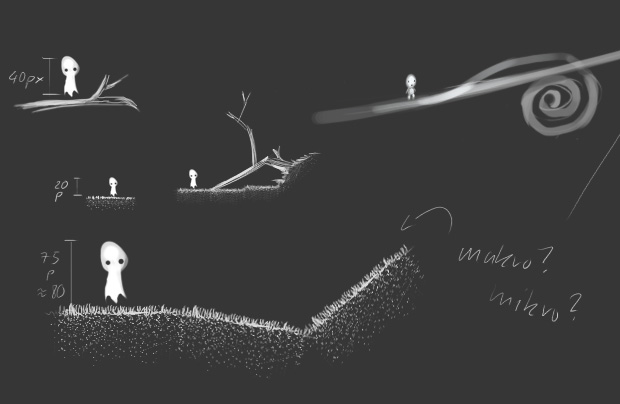
Before I could start designing the character, we had to decide on the proportions of the characters and the game world. How big should the character be in terms of pixels? Due to technical limitations of the iPhone we initially decided to use a sprite sheet of 512 × 512 pixels. The bigger the character would be, the fewer frames I could use for the character animation. But if I made the character too small the game would loose atmosphere and important details.
I sketched some sizes and we decided on 48 × 48 pixels which looked and felt good. But I proceeded to paint all the character states in 72 × 72 pixels, since it was only slightly more work and gave us more flexibility in case we changed our mind. However, after a while this still felt limiting and we decided to allocate even more graphics memory to the main character.
Already early on, I tried to capture a spooky atmosphere in the sketches. I drew the overall light situation quite dark with a point light source from behind and a weak bounce light hitting the front. This means most of the area beneath the ground is an even dark color, which draws the players attention to the ground surface where the spirits walk.
Later on we added a strongly blurred and colorful background to make the atmosphere feel less dark and more mystical, but the overall style of Spirits is still based on these early sketches and this lightning setup.
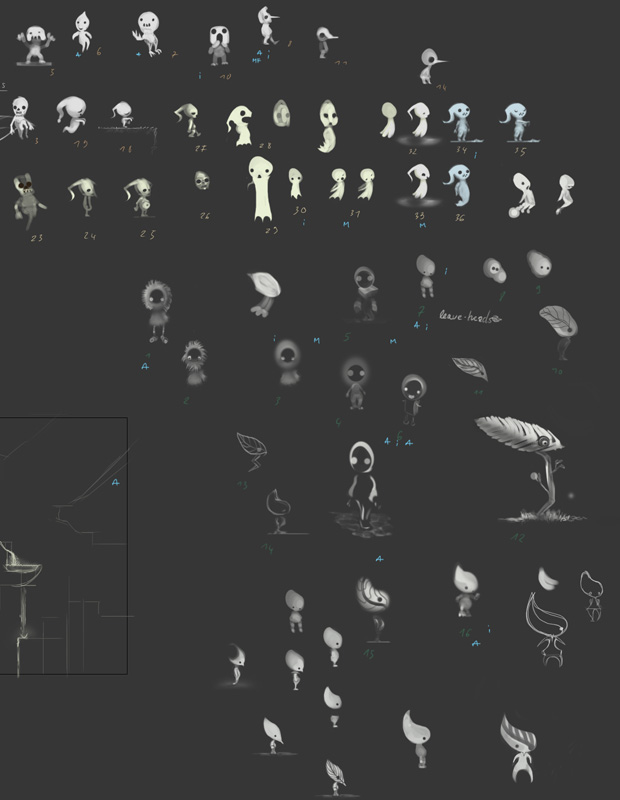
After the style and the proportions were roughly set, I began to sketch some more characters. I had the idea that the characters could be sleepwalking. This would explain why they would always wander heedlessly in one direction. At first this seemed great, but after trying it out it felt too artificial and not the direction we wanted to keep working in.
Another idea was born out of my love for insects. There are these amazing insects which mimic leaves and sticks for camouflage. Since the spirits inhabit the forest, I thought about the possibility that they could have adopted to the forest environment and therefore look more like leaves. I sketched this idea down quickly (see the lower right corner).
We further developed this idea and ended up with a character with a big leaf as a head, without arms but having legs. Because of the general ghostlike look of the sketches the character seemed like a spirit, which rises from a fallen leaf. This is what it ultimately became for us.
The character design influenced an important aspect of the game design. We knew from the beginning that we wanted to have a more dynamic component in the game, which influenced the spirits in some way. We were thinking about fluids and gas at first, but the leaf-like spirit character inspired us to use wind instead.
While I developed the character I also sketched the backgrounds. We wanted to have them in a painted style, but also create a lot of levels without using huge amount of memory. To do this we use small tiles and shapes that are put together into levels. So basically I painted a lot of small elements which we could put together in various ways. This worked well because of the flexible level editor we developed at the same time. The image below shows an early level which we used to test this process.
As mentioned before we wanted the atmosphere to feel less dark, so color was added to the backgrounds. I wanted the light to appear as if the viewer looks into the sunset through a dense forest. The viewer wouldn't see direct sunlight, only bounce light, illuminated fog and trees.
I made a quick sketch to figure out the color values. The bounce light in the foreground was reduced in strength to emphasize the effect of looking directly into the sunset.
Then I made the same thing again with abstract shapes and without distracting details.
The strong orange color in the background makes the overall atmosphere friendly but the dark blue (no it's not black!) ground color keeps the spooky and dark touch to it. We liked this approach and so we decided to go with it.
Below you can see the final art style we are using for Spirits.
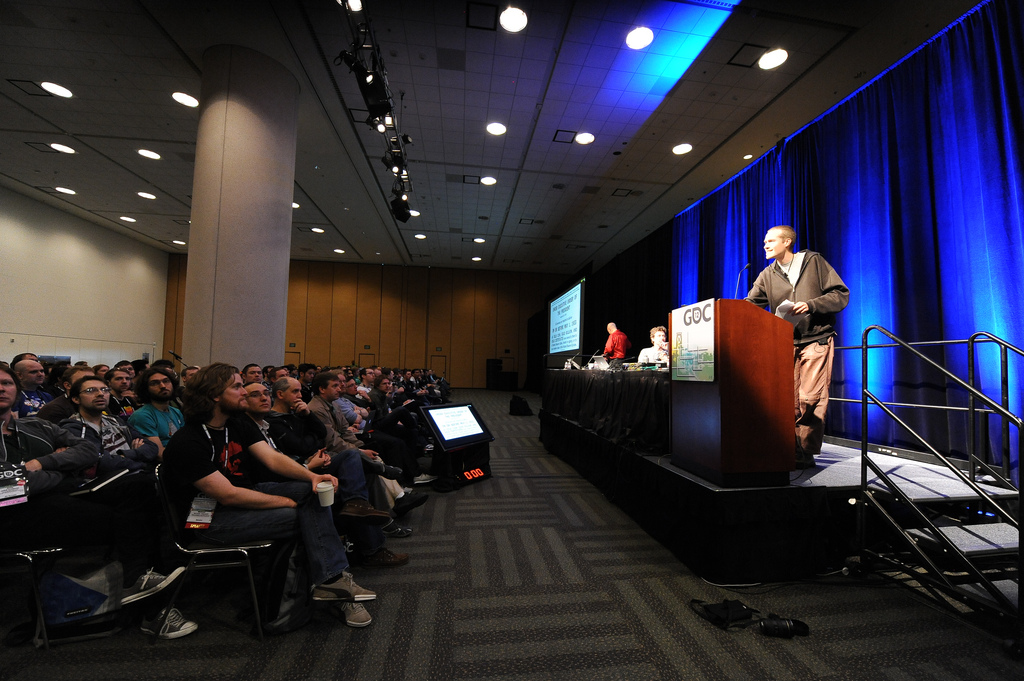
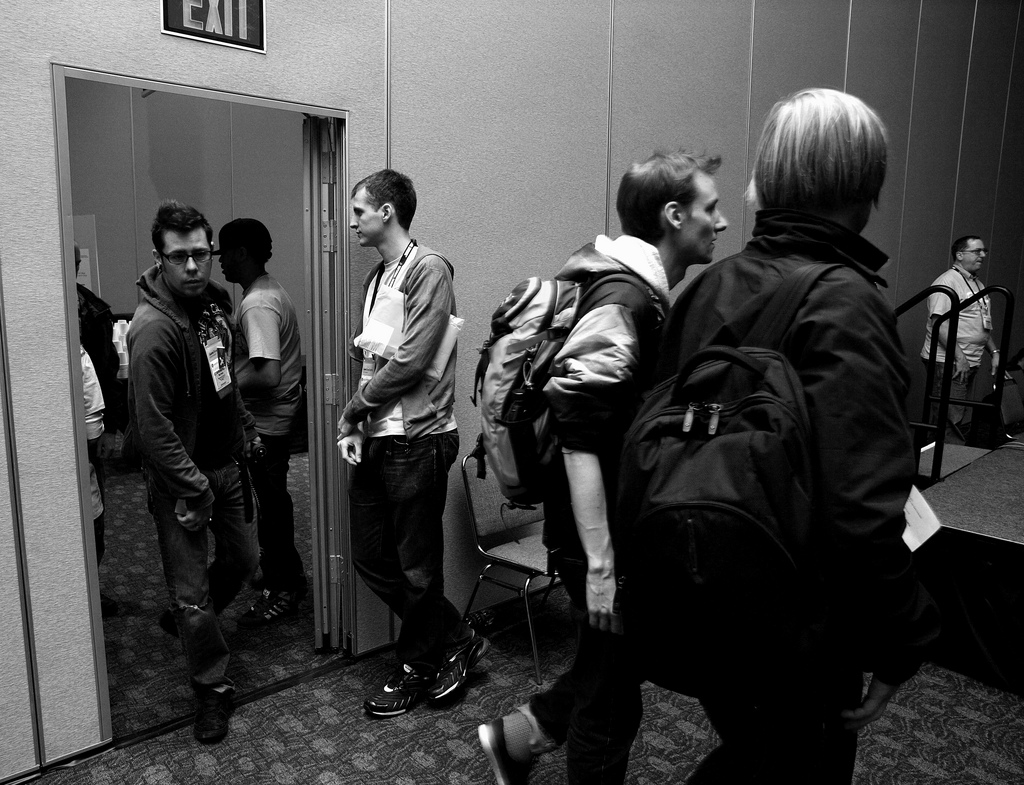
Andreas and Mattias on the way to the coffee break – Photo from Official GDC under Creative Commons
Mattias and me went to GDC last week. It was an intense week with a crazy amount of things going on every day. We met old and new friends. We got very competitive and physical with Copenhagen Game Collective's B.U.T.T.O.N.. Steph Thirion showed his new game Faraway at the Gamma IV party. Grapefrukt's awesome one-button RPG Glorg almost made it into the Gamma selection. Krystian Majewski's game Trauma was nominated at the IGF in three categories, one of them for Excellence in Audio due to our very own sound wiz Martin. Cactus won the Nuovo Award with Tuning and gave a memorable speech around minute 31. Chris Hecker told you to finish your game and was worried about scandinavian kids drinking too much. Ryan from the CO-OP show demanded equal media coverage for all games in his excellent rant. Eskil Steenberg explained why procedural is not randomness. Jonathan Blow did a tech talk about the implementation of the rewind feature in Braid. Semi Secret software announced Flixel for iPhone in their Canabalt postmortem. Superbrother's Sword & Sworcery looked amazing. Moo business cards with different motifs were the new thing.
Thanks everyone for a great week in San Francisco!
Spirits is our second game we are working on here at Spaces Of Play. While our first game Mr. Bounce was ported over from Flash, Spirits will be an original game design specifically developed for the iPhone and iPod touch.
We are a small team of four people working on the game. You can read more about our backgrounds on the About page. We will post updates of the game development progress here on the blog and on Twitter. We will also try to share some Behind-the-scenes knowledge that we think might be interesting to other developers.
If you happen to be in San Francisco at the GDC next week and would like to try out a preview build of our game, please drop us a mail and we'll be happy to meet you there.


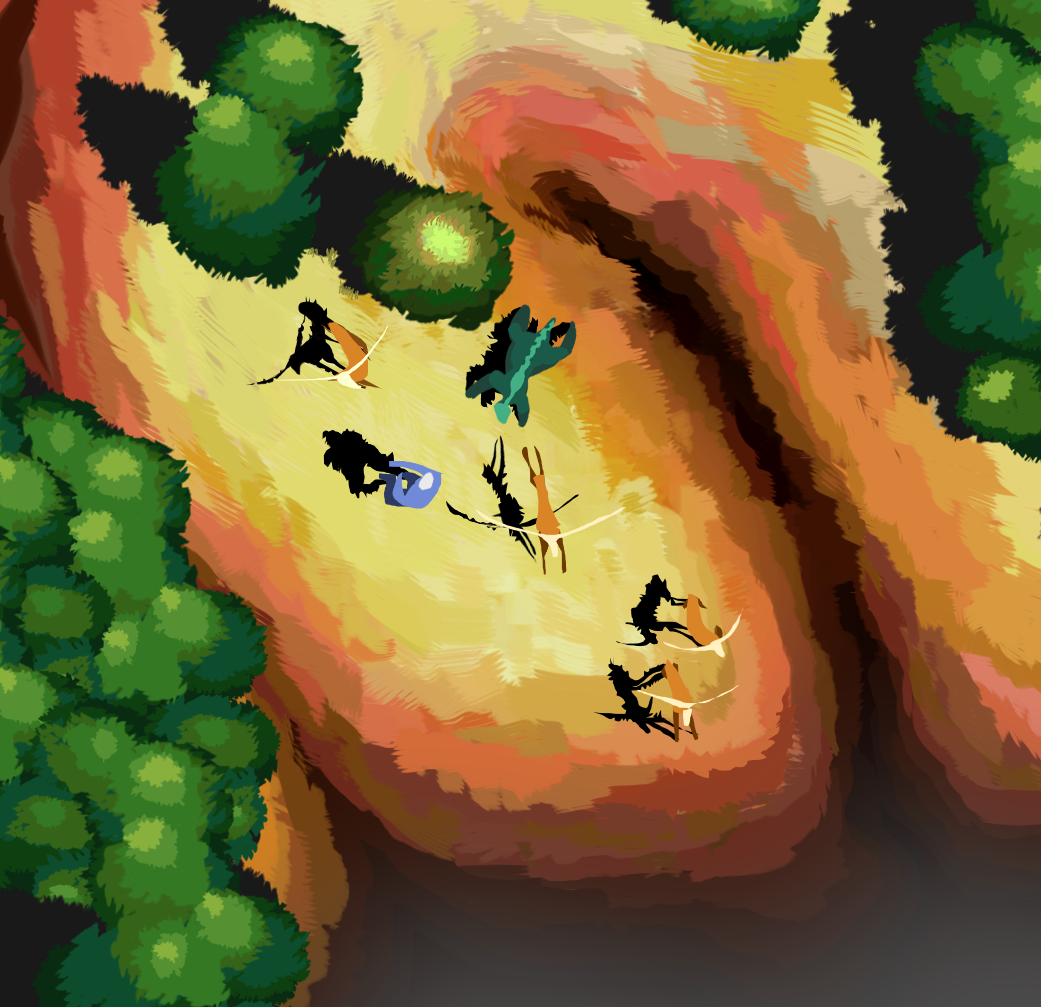
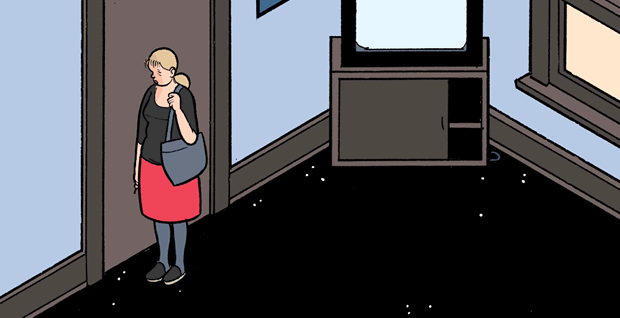
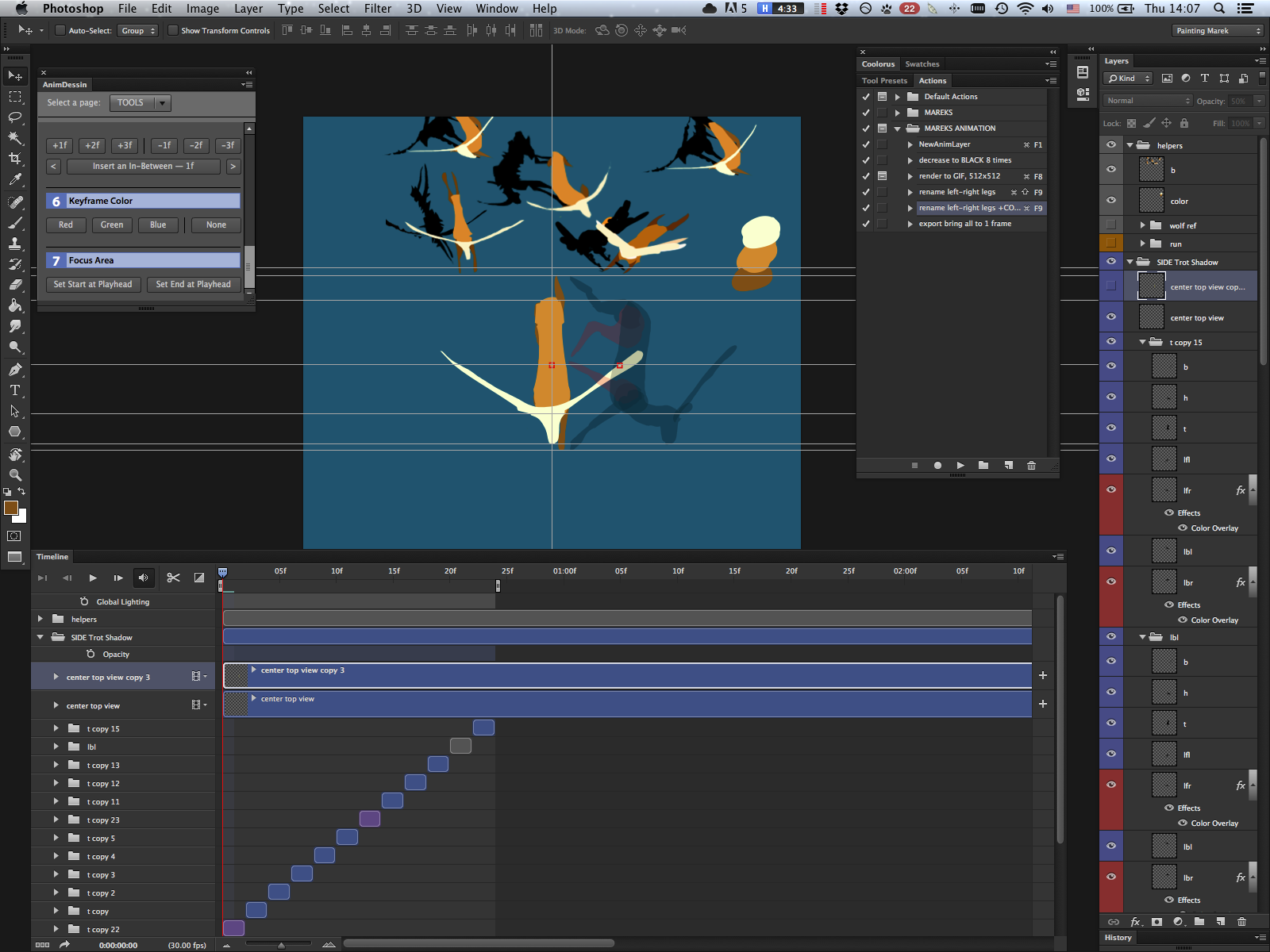 Soon the wolves in Future Unfolding won't be alone
 1.
1.  2.
2.  3.
3.  1.
1.  2.
2.  3.
3.  1.
1.  2.
2.  3.
3. 


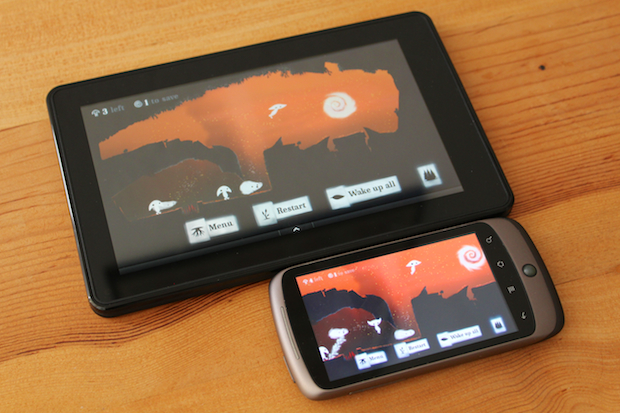 Spirits running on Kindle Fire and Nexus One

 Andreas and Mattias on the way to the coffee break – Photo from
